358 posters, 97 topics, 122 sessions, 958 authors, 239 institutions
ePostersLive by SciGen Technologies S.A. All rights reserved.
79th PostGraduate Assembly in Anesthesiology 2025
December 12 - 15, 2025 | New York City

3099
Determinants of Liver Transplantation in Critically Ill Patients with Acute-on-Chronic Liver Failure Transferred from Outside Hospitals for Urgent Transplant Evaluation
Poster Presenter
Part of Topic
Critical Care - Transplant
Introduction
•Acute-on-chronic liver failure (ACLF) is a rapidly progressive condition characterized by systemic inflammation, multi-organ dysfunction, and high mortality.1
•For patients at outside hospitals (OSH) who fail to improve despite maximal therapy, transfer for urgent liver transplant evaluation (LTE) represents a final attempt at definitive treatment.
•Many transferred patients ultimately do not undergo liver transplant (LT) due to rapid clinical decline or new contraindications identified after arrival.
•Little is known about which factors drive transplant eligibility and pre-transplant decisions in patients transferred to higher level centers for urgent LTE, as existing literature primarily explores post-transplant outcomes and mortality predictors in ACLF.2
•Understanding the factors influencing LT eligibility in this high-risk population is essential for improving patient selection, optimizing ICU management, and increasing access to LT.
•Goal: We aim to identify clinical and systemic variables associated with LT in this patient population.
Methods
•Single-center retrospective study including all adult patients with ACLF transferred from OSH for urgent LTE at William P. Clements Jr. University Hospital (tertiary academic center).
•Study period: January 1, 2021 – December 31, 2024
•Patients were identified using ICD-10 diagnosis codes for ACLF, then transfer for urgent LTEs was confirmed via manual review of the patients' medical chart.
•The primary outcome was receipt of liver transplantation.
Key Predictors of Liver Transplant Receipt
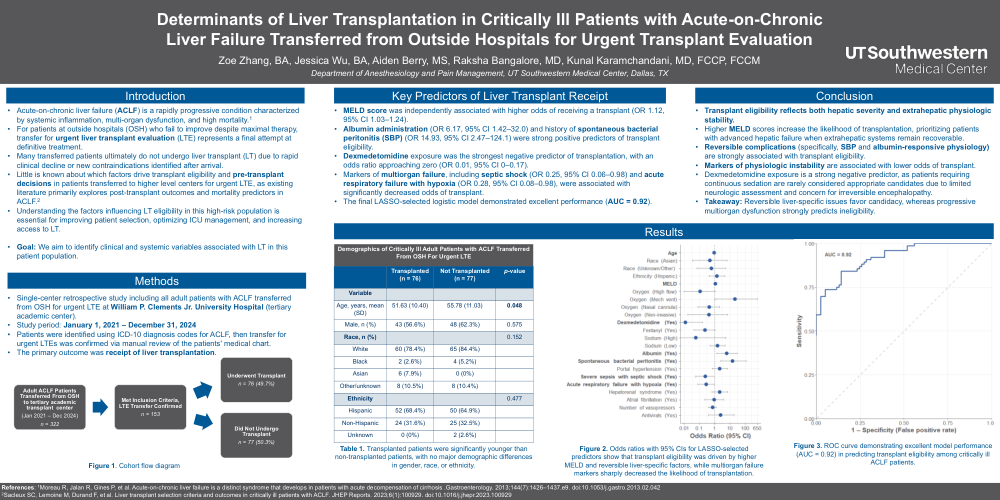
•MELD score was independently associated with higher odds of receiving a transplant (OR 1.12, 95% CI 1.03–1.24).
•Albumin administration (OR 6.17, 95% CI 1.42–32.0) and history of spontaneous bacterial peritonitis (SBP) (OR 14.93, 95% CI 2.47–124.1) were strong positive predictors of transplant eligibility.
•Dexmedetomidine exposure was the strongest negative predictor of transplantation, with an odds ratio approaching zero (OR 0.01, 95% CI 0–0.17).
•Markers of multiorgan failure, including septic shock (OR 0.25, 95% CI 0.06–0.98) and acute respiratory failure with hypoxia (OR 0.28, 95% CI 0.08–0.98), were associated with significantly decreased odds of transplant.
•The final LASSO-selected logistic model demonstrated excellent performance (AUC = 0.92).
Conclusion
•Transplant eligibility reflects both hepatic severity and extrahepatic physiologic stability.
•Higher MELD scores increase the likelihood of transplantation, prioritizing patients with advanced hepatic failure when extrahepatic systems remain recoverable.
•Reversible complications (specifically, SBP and albumin-responsive physiology) are strongly associated with transplant eligibility.
•Markers of physiologic instability are associated with lower odds of transplant.
•Dexmedetomidine exposure is a strong negative predictor, as patients requiring continuous sedation are rarely considered appropriate candidates due to limited neurologic assessment and concern for irreversible encephalopathy.
•Takeaway: Reversible liver-specific issues favor candidacy, whereas progressive multiorgan dysfunction strongly predicts ineligibility.