358 posters, 97 topics, 122 sessions, 958 authors, 239 institutions
ePostersLive by SciGen Technologies S.A. All rights reserved.
79th PostGraduate Assembly in Anesthesiology 2025
December 12 - 15, 2025 | New York City

3078
Use of EASy and Inferior Vena Cava Ultrasonography Before and After General Anesthesia Can Predict Patient Performance Intraoperatively and Postoperatively
Poster Presenter
Part of Topic
Critical Care - Perioperative Management
Use of EASy and Inferior Vena Cava Ultrasonography Before and After General Anesthesia Can Predict Patient Performance Intraoperatively and Postoperatively
Introduction
•Peri-induction hypotension affects 30–50% of surgical patients and worsens postoperative outcomes.
•Common risk tools (e.g., ASA status) rely on static variables and may miss physiologic vulnerability.
•Focused cardiac ultrasound (FoCUS) and IVC ultrasound can rapidly assess ventricular function and volume status at the bedside.
•The EASy exam (Extended Assessment of Sonography in the critically ill) is a ≤3-minute protocol that may identify risk before induction.
AIM
•Evaluate the feasibility of a pre-induction EASy–IVC ultrasound (exam time, image quality).
•Determine whether cardiopulmonary ultrasound phenotypes are associated with peri-induction hypotension.
•Explore whether physiologic ultrasound can support preoperative risk stratification.
Methods
•60 adult patients (ASA ≥ III) undergoing non-cardiac surgery (2024–2026) were prospectively enrolled.
•A pre-induction EASy–IVC ultrasound was performed at the bedside (subcostal 4-chamber, IVC long-axis, bilateral anterior lung).
•Exams were performed by anesthesia attendings and PGY-3 residents who completed ≥5 hours didactic + 5 hours hands-on training.
•Exams were timed (goal ≤3 min) and ultrasound findings categorized into ultrasound findings
•Primary outcomes: feasibility (exam time, image quality).
•Secondary outcome: pre-incision hypotension (MAP < 65 mmHg) and its association with pre-induction hypotension,
Results
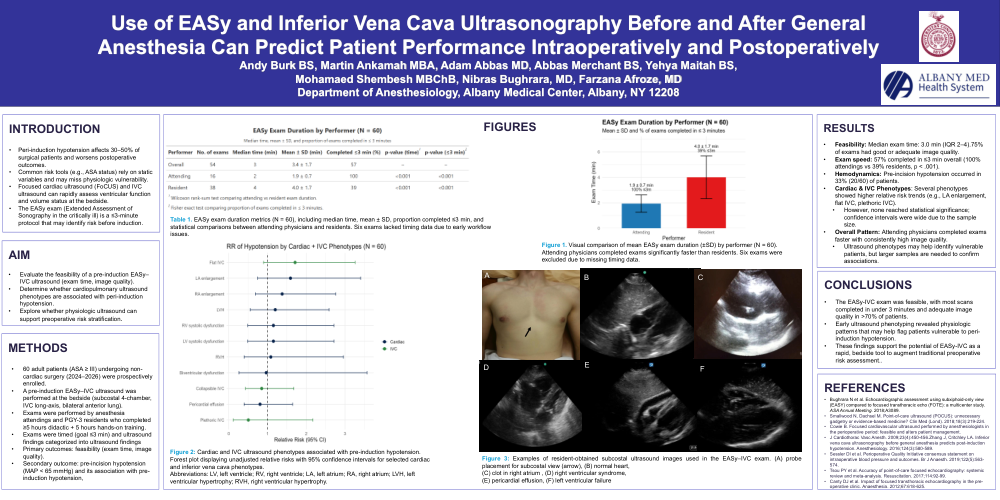
•Feasibility: Median exam time: 3.0 min (IQR 2–4).75% of exams had good or adequate image quality.
•Exam speed: 57% completed in ≤3 min overall (100% attendings vs 39% residents, p < .001).
•Hemodynamics: Pre-incision hypotension occurred in 33% (20/60) of patients.
•Cardiac & IVC Phenotypes: Several phenotypes showed higher relative risk trends (e.g., LA enlargement, flat IVC, plethoric IVC).
•However, none reached statistical significance; confidence intervals were wide due to the sample size.
•Overall Pattern: Attending physicians completed exams faster with consistently high image quality.
•Ultrasound phenotypes may help identify vulnerable patients, but larger samples are needed to confirm associations.
Conclusions
•The EASy-IVC exam was feasible, with most scans completed in under 3 minutes and adequate image quality in >70% of patients.
•Early ultrasound phenotyping revealed physiologic patterns that may help flag patients vulnerable to peri-induction hypotension.
•These findings support the potential of EASy-IVC as a rapid, bedside tool to augment traditional preoperative risk assessment.
References
•Bughrara N et al. Echocardiographic assessment using subxiphoid-only view (EASY) compared to focused transthoracic echo (FOTE): a multicenter study. ASA Annual Meeting. 2018;A3089.
•Smallwood N, Dachsel M. Point-of-care ultrasound (POCUS): unnecessary gadgetry or evidence-based medicine? Clin Med (Lond). 2018;18(3):219-224.
•Cowie B. Focused cardiovascular ultrasound performed by anesthesiologists in the perioperative period: feasible and alters patient management.
•J Cardiothorac Vasc Anesth. 2009;23(4):450-456.Zhang J, Critchley LA. Inferior vena cava ultrasonography before general anesthesia predicts post-induction hypotension. Anesthesiology. 2016;124(3):580-589.
•Sessler DI et al. Perioperative Quality Initiative consensus statement on intraoperative blood pressure and outcomes. Br J Anaesth. 2019;122(5):563-574.
•Tsou PY et al. Accuracy of point-of-care focused echocardiography: systemic review and meta-analysis. Resuscitation. 2017;114:92-99.
•Canty DJ et al. Impact of focused transthoracic echocardiography in the pre-operative clinic. Anaesthesia. 2012;67:618-625.