358 posters, 97 topics, 122 sessions, 958 authors, 239 institutions
ePostersLive by SciGen Technologies S.A. All rights reserved.
79th PostGraduate Assembly in Anesthesiology 2025
December 12 - 15, 2025 | New York City

3053
Racial and Ethnic Disparities in Rates of Spinal Cord Stimulation Therapy, Explants, and Complications: A National Propensity-Score Matched Analysis
Poster Presenter
Authors
Affiliations
Part of Topic
Pain Medicine - Regional and Acute Pain
•Persistent spinal pain syndrome (PSPS) involves chronic lumbar spinal pain of unclear origin, either persisting or emerging after surgical intervention.
•Spinal cord stimulation (SCS) is an effective treatment and has been shown to be superior to both analgesic medications and repeat surgical intervention.
•Disparities in SCS therapy have been reported by sex.
•However, racial and ethnic disparities in SCS explants and complications among patients already receiving SCS therapy remain unexplored.
•We used a national database to explore (1) whether racial and ethnic disparities exist in SCS utilization for PSPS and (2) evaluate potential disparities in explantation and complications (i.e., mechanical displacement, opioid dependence, mortality) among existing SCS patients.
•Retrospective cohort, TriNetX US Network
•Age >=18 with PSPS, 2005-2025, cohorts: race [White, Black, Asian] and ethnicity [Hispanic, non-Hispanic]
•Propensity-score matched (PSM) by age, race, ethnicity, anxiety disorders, mood disorders, depression, tobacco use, cancer/neoplasms, obesity, BMI, and anticoagulant use
•Ten-year outcomes: SCS therapy initiation, SCS explantation, SCS mechanical complications, opioid dependence, opioid overdose, and all-cause mortality
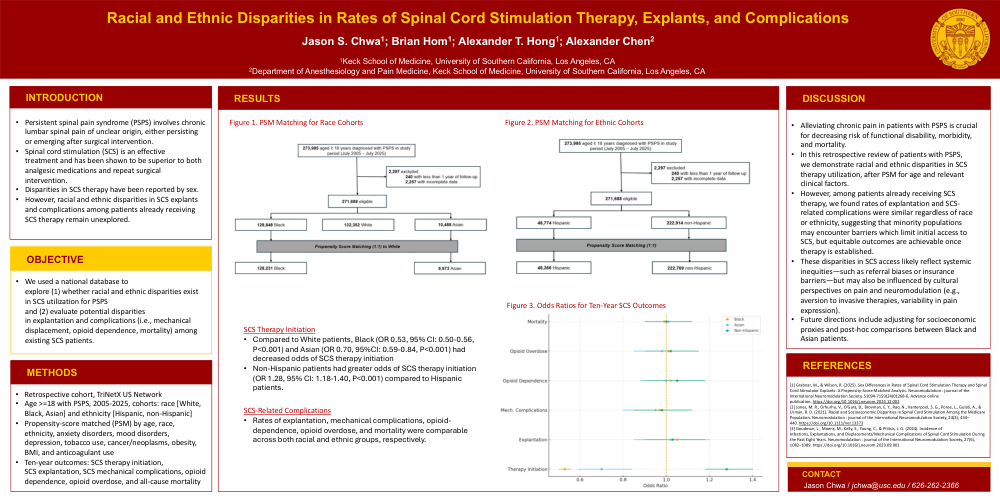
•Compared to White patients, Black (OR 0.53, 95% CI: 0.50-0.56, P<0.001) and Asian (OR 0.70, 95%CI: 0.59-0.84, P<0.001) had decreased odds of SCS therapy initiation
•Non-Hispanic patients had greater odds of SCS therapy initiation (OR 1.28, 95% CI: 1.18-1.40, P<0.001) compared to Hispanic patients.
•Rates of explantation, mechanical complications, opioid-dependence, opioid overdose, and mortality were comparable across both racial and ethnic groups, respectively.
•Alleviating chronic pain in patients with PSPS is crucial for decreasing risk of functional disability, morbidity, and mortality.
•In this retrospective review of patients with PSPS, we demonstrate racial and ethnic disparities in SCS therapy utilization, after PSM for age and relevant clinical factors.
•However, among patients already receiving SCS therapy, we found rates of explantation and SCS-related complications were similar regardless of race or ethnicity, suggesting that minority populations may encounter barriers which limit initial access to SCS, but equitable outcomes are achievable once therapy is established.
•These disparities in SCS access likely reflect systemic inequities—such as referral biases or insurance barriers—but may also be influenced by cultural perspectives on pain and neuromodulation (e.g., aversion to invasive therapies, variability in pain expression).
•Future directions include adjusting for socioeconomic proxies and post-hoc comparisons between Black and Asian patients.