358 posters, 97 topics, 122 sessions, 958 authors, 239 institutions
ePostersLive by SciGen Technologies S.A. All rights reserved.
79th PostGraduate Assembly in Anesthesiology 2025
December 12 - 15, 2025 | New York City

3030
Gastrointestinal Hemorrhage during MCS: A Clinical Challenge
Poster Presenter
Part of Topic
Cardiovascular - Critical Care
Gastrointestinal Hemorrhage during MCS: A Clinical Challenge
Introduction
End-organ hypoperfusion from cardiopulmonary shock may require mechanical circulatory support (MCS).1-3 However, patients receiving MCS risk development of hemorrhagic complications including gastrointestinal bleeding.4-6 Examining the relationships of risk factors for these complications may improve our understanding.7 The purpose of this investigation was to study the risk for gastrointestinal (GI) bleeding in MCS patients.
Methods
Following IRB approval, patient characteristics, previously reported comorbidities4-6 and the incidence of GI bleeding were studied in this population from January 2017 to October 2023. The clinical variables underwent machine learning.8
Results
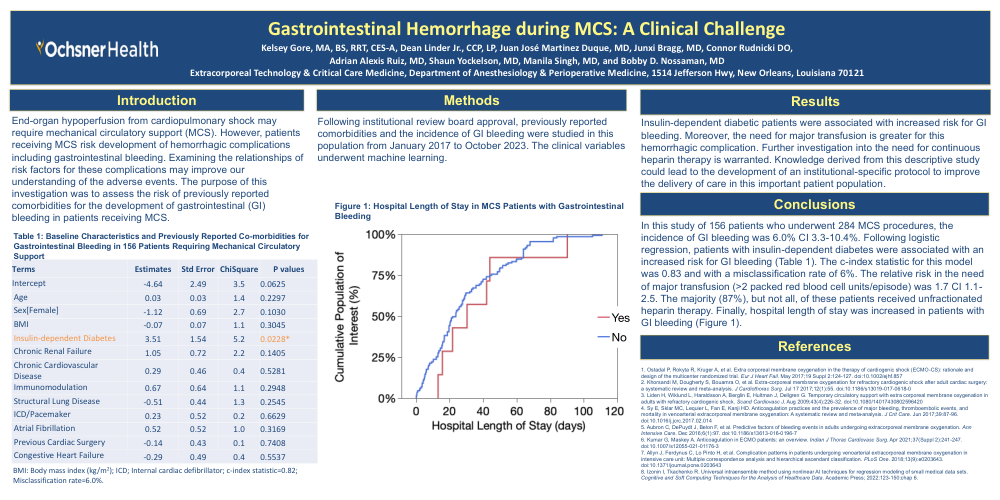
In this study of 156 patients who underwent 284 MCS procedures, the incidence of GI bleeding was 6.0% CI 3.3-10.4%. Following machine learning, patients with insulin-dependent diabetes were associated with an increased risk for GI bleeding (Table 1). The c-index statistic for this model was 0.83 and with a misclassification rate of 6%. The relative risk in the need of major transfusion (>2 packed red blood cell units/episode) was 1.7 CI 1.1-2.5. The majority (87%), but not all, of these patients received unfractionated heparin therapy. Finally, hospital length of stay was increased in patients with GI bleeding (Figure 1).
Conclusion
Insulin-dependent diabetic patients were associated with increased risk for GI bleeding. Moreover, the need for major transfusion is greater for this hemorrhagic complication. Further investigation into the need for continuous heparin therapy is warranted. Knowledge derived from this descriptive study could lead to the development of an institutional-specific protocol to improve the delivery of care in this important patient population.
References
1.Ostadal P, Rokyta R, Kruger A, et al. Extra corporeal membrane oxygenation in the therapy of cardiogenic shock (ECMO-CS): rationale and design of the multicenter randomized trial. Eur J Heart Fail. May 2017;19 Suppl 2:124-127. doi:10.1002/ejhf.857
2.Khorsandi M, Dougherty S, Bouamra O, et al. Extra-corporeal membrane oxygenation for refractory cardiogenic shock after adult cardiac surgery: a systematic review and meta-analysis. J Cardiothorac Surg. Jul 17 2017;12(1):55. doi:10.1186/s13019-017-0618-0
3.Liden H, Wiklund L, Haraldsson A, Berglin E, Hultman J, Dellgren G. Temporary circulatory support with extra corporeal membrane oxygenation in adults with refractory cardiogenic shock. Scand Cardiovasc J. Aug 2009;43(4):226-32. doi:10.1080/14017430802596420
4.Sy E, Sklar MC, Lequier L, Fan E, Kanji HD. Anticoagulation practices and the prevalence of major bleeding, thromboembolic events, and mortality in venoarterial extracorporeal membrane oxygenation: A systematic review and meta-analysis. J Crit Care. Jun 2017;39:87-96. doi:10.1016/j.jcrc.2017.02.014
5.Aubron C, DePuydt J, Belon F, et al. Predictive factors of bleeding events in adults undergoing extracorporeal membrane oxygenation. Ann Intensive Care. Dec 2016;6(1):97. doi:10.1186/s13613-016-0196-7
6.Kumar G, Maskey A. Anticoagulation in ECMO patients: an overview. Indian J Thorac Cardiovasc Surg. Apr 2021;37(Suppl 2):241-247. doi:10.1007/s12055-021-01176-3
7.Allyn J, Ferdynus C, Lo Pinto H, et al. Complication patterns in patients undergoing venoarterial extracorporeal membrane oxygenation in intensive care unit: Multiple correspondence analysis and hierarchical ascendant classification. PLoS One. 2018;13(9):e0203643. doi:10.1371/journal.pone.0203643
8.Izonin I, Tkachenko R. Universal intraensemble method using nonlinear AI techniques for regression modeling of small medical data sets. Cognitive and Soft Computing Techniques for the Analysis of Healthcare Data. Academic Press; 2022:123-150:chap 6.