358 posters, 97 topics, 122 sessions, 958 authors, 239 institutions
ePostersLive by SciGen Technologies S.A. All rights reserved.
79th PostGraduate Assembly in Anesthesiology 2025
December 12 - 15, 2025 | New York City

2138
Severe Aortic Insufficiency and Cardiovascular Collapse from Type A Aortic Dissection with Dissection Flap Prolapse into Aortic Valve
Part of Topic
Cardiovascular - Critical Care
INTRODUCTION
Acute Type A aortic dissection is a surgical emergency with
mortality increasing 1–2 percent for every hour of delay. While
severe aortic insufficiency is a recognized complication, intimal flap
prolapse into the aortic valve is a rare mechanism of abrupt
hemodynamic collapse. Early recognition of malperfusion and
rapidly deteriorating cardiac function is essential to guide
intraoperative monitoring and management.
CASE PRESENTATION
● A 41-year-old man with obesity presented with slurred speech, left
facial droop, and right shoulder pain.
● CT chest confirmed an acute Type A aortic dissection.
● In the OR, a right radial arterial line showed MAP ~50 mmHg, while
the left arm cuff measured significantly higher, raising concern for
regional malperfusion.
● A left femoral arterial line was placed for more accurate monitoring.
● Pre-bypass ABG revealed severe hyperkalemia with early
myoglobinuria.
● Right cerebral oximetry signal was absent prior to cardiopulmonary
bypass.
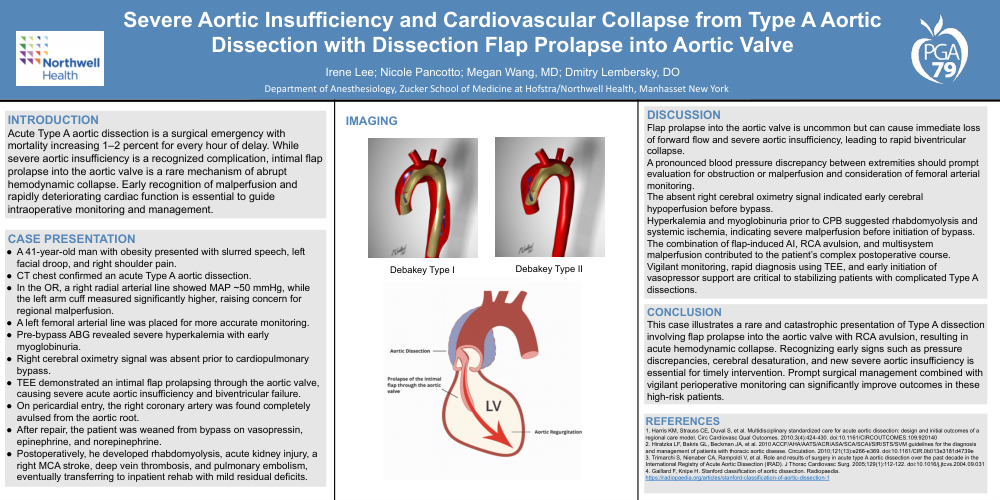
● TEE demonstrated an intimal flap prolapsing through the aortic valve,
causing severe acute aortic insufficiency and biventricular failure.
● On pericardial entry, the right coronary artery was found completely
avulsed from the aortic root.
● After repair, the patient was weaned from bypass on vasopressin,
epinephrine, and norepinephrine.
● Postoperatively, he developed rhabdomyolysis, acute kidney injury, a
right MCA stroke, deep vein thrombosis, and pulmonary embolism,
eventually transferring to inpatient rehab with mild residual deficits.
DISCUSSION
Flap prolapse into the aortic valve is uncommon but can cause immediate loss
of forward flow and severe aortic insufficiency, leading to rapid biventricular
collapse.
A pronounced blood pressure discrepancy between extremities should prompt
evaluation for obstruction or malperfusion and consideration of femoral arterial
monitoring.
The absent right cerebral oximetry signal indicated early cerebral
hypoperfusion before bypass.
Hyperkalemia and myoglobinuria prior to CPB suggested rhabdomyolysis and
systemic ischemia, indicating severe malperfusion before initiation of bypass.
The combination of flap-induced AI, RCA avulsion, and multisystem
malperfusion contributed to the patient’s complex postoperative course.
Vigilant monitoring, rapid diagnosis using TEE, and early initiation of
vasopressor support are critical to stabilizing patients with complicated Type A
dissections.