358 posters, 97 topics, 122 sessions, 958 authors, 239 institutions
ePostersLive by SciGen Technologies S.A. All rights reserved.
79th PostGraduate Assembly in Anesthesiology 2025
December 12 - 15, 2025 | New York City

3016
Muscle Relaxant-Free Intubation in Children Under Two Years Undergoing Short-Duration Surgery: A Retrospective Cohort Study
Poster Presenter
Part of Topic
Muscle Relaxant-Free Intubation in Children Under Two Years Undergoing Short-Duration Surgery: A Retrospective Cohort Study
Introduction/Hypothesis:
Minimizing pharmacologic exposure during pediatric anesthesia is increasingly emphasized, particularly in infants and toddlers due to their immature physiology, limited drug clearance, and heightened susceptibility to adverse effects. Neuromuscular blocking agents (NMBAs) are routinely used to facilitate endotracheal intubation; however, they carry risks such as residual paralysis, delayed emergence, and postoperative respiratory complications. Avoiding muscle relaxants during intubation has been proposed as a strategy to promote faster recovery, especially in short-duration procedures, by relying instead on deep inhalational or intravenous anesthesia.
While previous studies have explored this technique in older children, data remain scarce in infants under a two-year-old, a population particularly prone to airway reactivity and hemodynamic instability. Given the clinical relevance of optimizing perioperative efficiency and safety in this age group, we hypothesized that intubation without muscle relaxants would be associated with shorter recovery times and comparable airway and cardiovascular safety in young children undergoing short-duration elective surgeries.
Study Design/Methods:
We conducted a retrospective cohort study at a tertiary pediatric surgical center, analyzing children under two years of age who underwent elective, non-airway surgeries lasting less than 60 minutes under general anesthesia with endotracheal intubation between January 2018 and December 2023. Patients were divided into two groups based on intubation method: Group A (n=250) underwent intubation without neuromuscular blocking agents (NMBAs), using deep anesthesia alone; Group B (n=250) received short-acting NMBAs (atracurium or rocuronium).
Exclusion criteria included emergency surgeries, airway procedures, prone or lateral positioning, ASA > III, or congenital airway anomalies. Induction was standardized using sevoflurane or intravenous propofol and fentanyl. No videolaryngoscopes were used. In Group A, intubation was achieved after confirming jaw relaxation under deep anesthesia.
Primary outcomes were time to extubation and post-anesthesia care unit (PACU) stay. Secondary outcomes included intraoperative airway events (desaturation, laryngospasm) and hemodynamic fluctuations. Airway events were documented in real-time by anesthesia providers using predefined criteria. To minimize selection bias, strict inclusion criteria and equal group allocation were applied. Statistical analysis included t-tests and chi-square comparisons. A post hoc power calculation confirmed an adequate sample size to detect observed differences in PACU stay. Findings are presented with 95% confidence intervals and p-values.
Results:
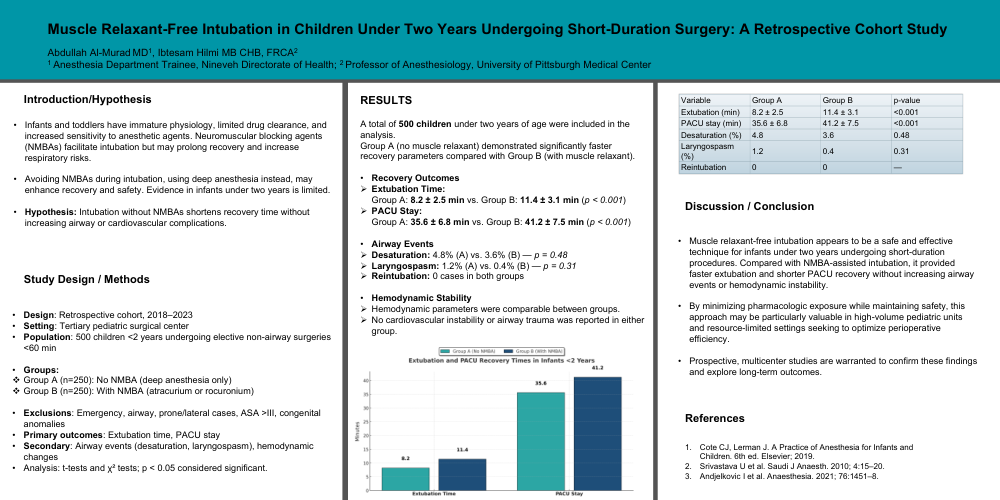
A total of 500 children were analyzed. Group A (no muscle relaxant) had significantly shorter extubation times (8.2 ± 2.5 vs. 11.4 ± 3.1 minutes, p < 0.001) and PACU durations (35.6 ± 6.8 vs. 41.2 ± 7.5 minutes, p < 0.001) compared to Group B. Desaturation occurred in 4.8% of Group A and 3.6% of Group B (p = 0.48); laryngospasm occurred in 1.2% and 0.4%, respectively (p = 0.31). No patients required reintubation. Hemodynamic changes during induction and emergence were mild and comparable between groups. No clinically significant cardiovascular instability or airway trauma was observed in either group.
Discussion/Conclusion:
This study demonstrates that muscle relaxant-free endotracheal intubation is a safe and effective technique in children under two years old undergoing short-duration elective surgeries. Compared to those who received neuromuscular blocking agents, patients intubated without muscle-relaxants experienced significantly faster extubation and shorter PACU stays, without an increase in airway complications or hemodynamic instability.
These findings suggest that eliminating NMBAs may enhance perioperative efficiency and minimize pharmacologic exposure in appropriately selected infants and toddlers. The low incidence of desaturation and laryngospasm supports the feasibility of this technique when adequate anesthetic depth is achieved.
Given the increasing emphasis on recovery optimization and drug minimization in pediatric anesthesia, this approach may be particularly valuable in high-volume or resource-limited settings. Although retrospective in design, the study’s large sample size and strict inclusion criteria strengthen its clinical relevance. Future prospective multicenter trials are warranted to validate these results and explore long-term respiratory and neurodevelopmental outcomes.
References:
- Cote CJ, Lerman J. A Practice of Anesthesia for Infants and Children. 6th ed. Elsevier; 2019.
- Srivastava U, et al. Saudi J Anaesth. 2010;4:15–20.
- Andjelkovic I, et al. Anaesthesia. 2021;76:1451–8.