358 posters, 97 topics, 122 sessions, 958 authors, 239 institutions
ePostersLive by SciGen Technologies S.A. All rights reserved.
79th PostGraduate Assembly in Anesthesiology 2025
December 12 - 15, 2025 | New York City

2254
Management of Refractory Differential Hypoxia on Hybrid V-AV ECMO with VV-AA Reconfiguration as a Bridge to Lung Transplant
Poster Presenter
Authors
Affiliations
Part of Topic
Cardiovascular - Critical Care
Management of Refractory Differential Hypoxia on Hybrid V-AV ECMO with VV-AA Reconfiguration as a Bridge to Lung Transplant
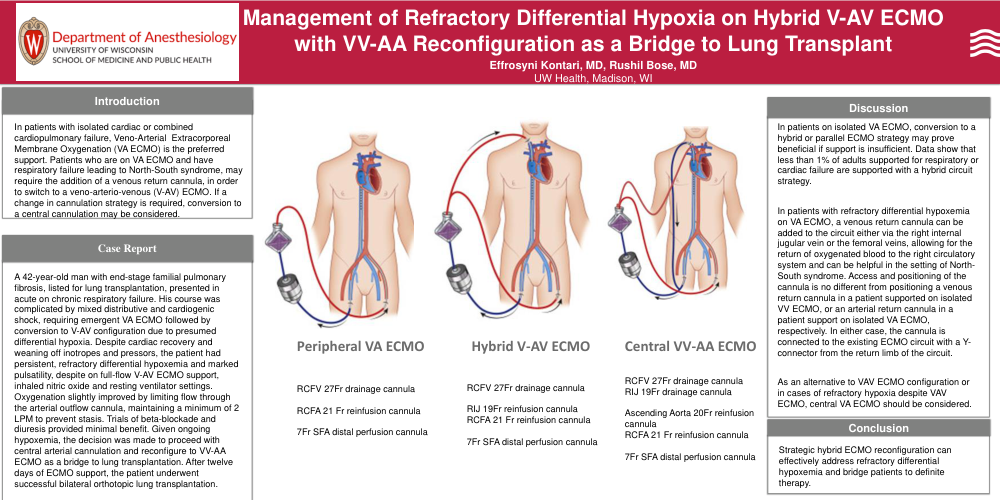
A 42-year-old man with end-stage familial pulmonary fibrosis, listed for lung transplantation, presented in acute on chronic respiratory failure. His course was complicated by mixed distributive and cardiogenic shock, requiring emergent VA ECMO followed by conversion to V-AV configuration due to presumed differential hypoxia. Despite cardiac recovery and weaning off inotropes and pressors, the patient had persistent, refractory differential hypoxemia and marked pulsatility, despite on full-flow V-AV ECMO support, inhaled nitric oxide and resting ventilator settings. Oxygenation slightly improved by limiting flow through the arterial outflow cannula, maintaining a minimum of 2 LPM to prevent stasis. Trials of beta-blockade and diuresis provided minimal benefit. Given ongoing hypoxemia, the decision was made to proceed with central arterial cannulation and reconfigure to VV-AA ECMO as a bridge to lung transplantation. After twelve days of ECMO support, the patient underwent successful bilateral orthotopic lung transplantation.
Cerebral or myocardial ischemia can complicate the management of patients on VA ECMO who have pulmonary failure but preserved cardiac function—a condition known as differential hypoxia or NorthSouth syndrome. In such cases, a second return cannula may be placed to create a hybrid V-AV ECMO configuration to redirect oxygenated blood to the upper body. However, when native cardiac function is recovered, particularly in high-output states, significant shunting through poorly oxygenated native lungs may persist. This results in a low ECMO blood flow–to– cardiac output ratio, limiting effective oxygenation despite full V-AV ECMO support. To improve oxygenation, beta-blockade or diuresis can be attempted. In refractory cases, advanced hybrid ECMO circuits, including central cannulation and VV-AA reconfiguration, may be considered, as a bridge to the lung transplantation. Hybrid ECMO strategies are used in less than 1% of adults supported for respiratory or cardiac failure. Outcomes among these patients are variable and current data do not clearly demonstrate a mortality benefit from hybrid ECMO use. Nevertheless, these approaches are often reserved for patients with severe or complex pathophysiology. An individualized, case-based strategy is essential to optimize support for this critically ill population.
1. Cove ME. Disrupting differential hypoxia in peripheral venoarterial extracorporeal membrane oxygenation. Crit Care. 2015 Jul 22;19(1):280.
2. Hybrid and parallel extracorporeal membrane oxygenation circuits Shah, Aakash et al. JTCVS Techniques, Volume 8, 77 - 85.
3. Bernhardt AM, Copeland H, Deswal A, Gluck J, Givertz MM; Task Force 1; Task Force 2; Task Force 3; Task Force 4. The International Society for Heart and Lung Transplantation/Heart Failure Society of America Guideline on Acute Mechanical Circulatory Support. J Card Fail. 2023 Mar;29(3):304-374.