358 posters, 97 topics, 122 sessions, 958 authors, 239 institutions
ePostersLive by SciGen Technologies S.A. All rights reserved.
79th PostGraduate Assembly in Anesthesiology 2025
December 12 - 15, 2025 | New York City

2253
Post Dural Puncture Headache in a Challenging Case
Poster Presenter
Authors
Affiliations
Part of Topic
Obstetrics - Pain Medicine
Management of Post dural puncture Headache in a medically Challenging Patient
Sami Mustafa A.Maksoud, Athik Sajeermohammed, Anwar Ul Hud
Department of Anesthesiology, ICU and Perioperative Medicine, Hamad Medical Corporation, Doha, Qatar
INTRODUCTION
Post-Dural Puncture Headache (PDPH) is a recognized complication of neuraxial anesthesia and remains a therapeutic challenge (2). Although the Epidural Blood Patch (EBP) is considered the gold standard for treating PDPH, it carries risks such as inadvertent dural puncture and complications, especially in patients with contraindications (2). The sphenopalatine ganglion block (SPGB) has emerged as a promising, less invasive treatment with growing evidence supporting its analgesic efficacy.
CASE DESCRIPTION
A 69-year-old female underwent vaginal wall repair under combined spinal-epidural (CSE) anesthesia. Her medical history included ischemic stroke and multiple comorbidities. She had been on long-term clopidogrel (Plavix®) 75 mg daily, which was restarted on the first postoperative day as per neurologist recommendation. The patient also had a known allergy to NSAIDs, including diclofenac, ibuprofen, and aspirin. Following the procedure, the patient developed severe headache. A neurology consultation was obtained, and brain CT, MRI, MRA, and MRV were performed to rule out acute neurological pathology and the results were unremarkable.
The anesthesiology team was consulted, and conservative management was initiated. Due to her NSAID allergy, analgesic options were limited, and she was started on oral tramadol TID for symptom relief. On follow-up the next day, the patient reported worsening of PDPH symptoms, including postural headache, tinnitus, photophobia, and nausea, significantly affecting her daily activities. An epidural blood patch (EBP) was the next step of treatment; however, recent clopidogrel use contraindicated the procedure at that time. As EBP would require a waiting period of approximately five days, alternative treatment options were discussed with the patient.
With informed consent, a sphenopalatine ganglion block (SPGB) was performed at the bedside. The patient was connected to monitors, and the intranasal dripping technique by using 2% lidocain and 5% levobupivocain were was used to administer the block. The procedure resulted in immediate and complete symptom relief. The patient resumed oral intake, mobilized independently within minutes, and was discharged pain-free the following day.
Five days later, the patient returned with mild neck pain and headache. A repeat SPGB was administered with complete resolution of symptoms. After 1 week follow-up via telephone was done, the patient expressed full satisfaction with her care and appreciated the efficacy of the non-invasive management approach.
Post-dural puncture headache (PDPH) is a well-recognized complication of neuraxial anesthesia, particularly in procedures involving dural puncture such as combined spinal-epidural (CSE) anesthesia. It is characterized by a positional headache accompanied by symptoms such as nausea, neck pain, photophobia, and tinnitus. The standard treatment for severe or persistent PDPH is an epidural blood patch (EBP), which is highly effective but carries inherent risks, particularly in patients on antiplatelet or anticoagulant therapy.
In this case, recent clopidogrel use contraindicated EBP due to the elevated risk of spinal hematoma. Given the patient's allergy to NSAIDs and poor response to conservative management, an alternative non-invasive option was needed. The sphenopalatine ganglion block (SPGB) was selected as a viable and safe intervention.
Discussion:
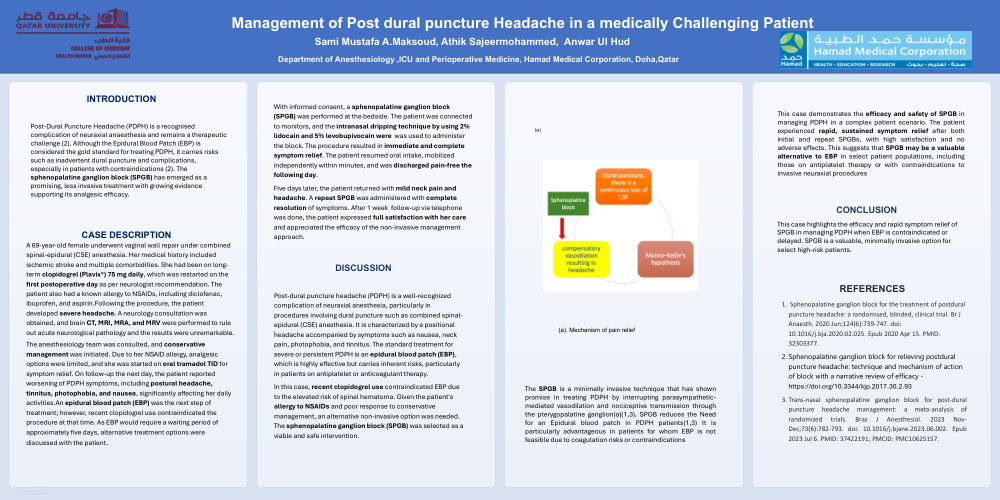
The SPGB is a minimally invasive technique that has shown promise in treating PDPH by interrupting parasympathetic-mediated vasodilation and nociceptive transmission through the pterygopalatine ganglion(a)(1,3). SPGB reduces the Need for an Epidural blood patch in PDPH patients(1,3) It is particularly advantageous in patients for whom EBP is not feasible due to coagulation risks or contraindications
This case demonstrates the efficacy and safety of SPGB in managing PDPH in a complex patient scenario. The patient experienced rapid, sustained symptom relief after both initial and repeat SPGBs, with high satisfaction and no adverse effects. This suggests that SPGB may be a valuable alternative to EBP in select patient populations, including those on antiplatelet therapy or with contraindications to invasive neuraxial procedures
CONCLUSION
This case highlights the efficacy and rapid symptom relief of SPGB in managing PDPH when EBP is contraindicated or delayed. SPGB is a valuable, minimally invasive option for select high-risk patients.
REFERENCES
- Sphenopalatine ganglion block for the treatment of postdural puncture headache: a randomised, blinded, clinical trial. Br J Anaesth. 2020 Jun;124(6):739-747. doi: 10.1016/j.bja.2020.02.025. Epub 2020 Apr 15. PMID: 32303377.
- Sphenopalatine ganglion block for relieving postdural puncture headache: technique and mechanism of action of block with a narrative review of efficacy -https://doi.org/10.3344/kjp.2017.30.2.93
- Trans-nasal sphenopalatine ganglion block for post-dural puncture headache management: a meta-analysis of randomized trials. Braz J Anesthesiol. 2023 Nov-Dec;73(6):782-793. doi: 10.1016/j.bjane.2023.06.002. Epub 2023 Jul 6. PMID: 37422191; PMCID: PMC10625157