358 posters, 97 topics, 122 sessions, 958 authors, 239 institutions
ePostersLive by SciGen Technologies S.A. All rights reserved.
79th PostGraduate Assembly in Anesthesiology 2025
December 12 - 15, 2025 | New York City

2200
A Perfusion Catch 22 - When Does The Aorta Beat The Brain?
Poster Presenter
Part of Topic
Critical Care
Introduction:
Hypertensive crisis is a potentially dangerous condition typically defined as a systolic and diastolic blood pressure of greater than 180 mmHg and 120 mmHg, respectively. It can be subdivided into hypertensive emergency or urgency depending on the presence of end-organ damage. Examples of end-organ damage include hypertensive encephalopathy, myocardial infarction, aortic dissection, and acute kidney injury. Thus, timely identification and appropriate management is necessary to prevent long-term complications.
The mainstay of managing hypertensive crises is gradual blood pressure reduction, with a maximum 25% reduction in the first hour, and then a slow reduction to baseline over the next 24-48 hours. A gradual rather than aggressive approach is recommended to prevent ischemia, and complications such as stroke, in areas that are used to chronically elevated pressures.
There are exceptions to this rule, with one being the presence of an aortic dissection. In this case, management typically involves rapid blood pressure reduction and impulse control with beta blockers. The opposing management goals of hypertensive emergency and aortic dissection presents a unique clinical challenge.
Case Presentation:
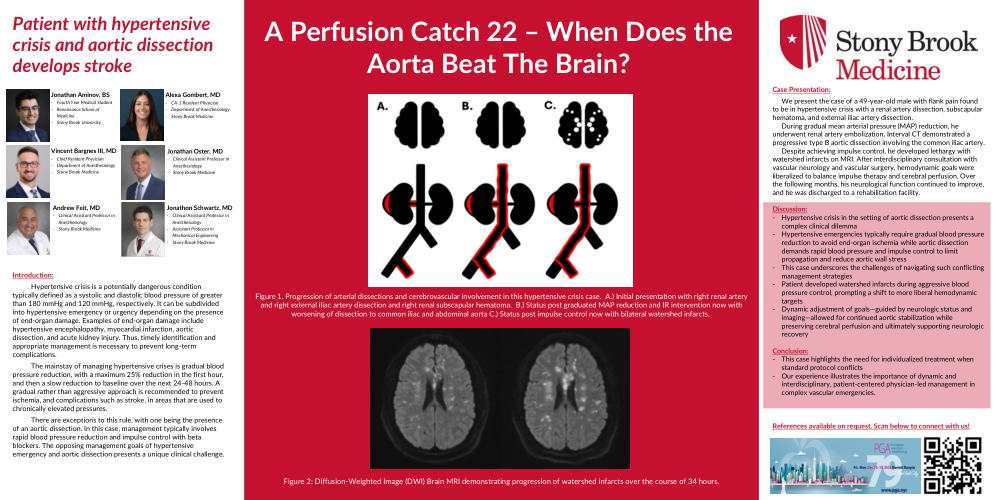
We present the case of a 49-year-old male with flank pain found to be in hypertensive crisis with a renal artery dissection, subscapular hematoma, and external iliac artery dissection.
During gradual mean arterial pressure (MAP) reduction, he underwent renal artery embolization. Interval CT demonstrated a progressive type B aortic dissection involving the common iliac artery.
Despite achieving impulse control, he developed lethargy with watershed infarcts on MRI. After interdisciplinary consultation with vascular neurology and vascular surgery, hemodynamic goals were liberalized to balance impulse therapy and cerebral perfusion. Over the following months, his neurological function continued to improve, and he was discharged to a rehabilitation facility.
Discussion:
Conclusion: