358 posters, 97 topics, 122 sessions, 958 authors, 239 institutions
ePostersLive by SciGen Technologies S.A. All rights reserved.
79th PostGraduate Assembly in Anesthesiology 2025
December 12 - 15, 2025 | New York City

2177
Non-Dialytic Management of Severe Ayahuasca-Induced Rhabdomyolysis with AKI
Poster Presenter
Authors
Affiliations
Part of Topic
Critical Care
Non-Dialytic Management of Severe Ayahuasca-Induced Rhabdomyolysis with AKI
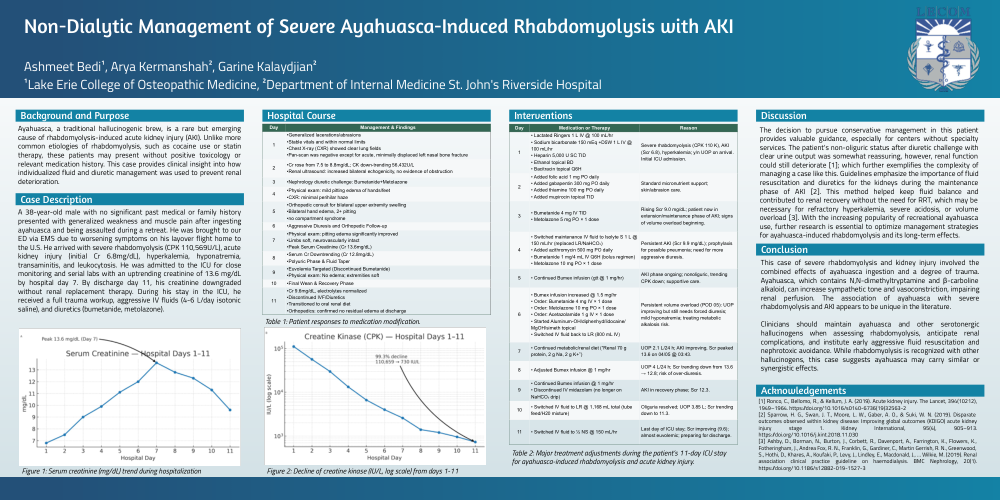
Background and Purpose: Ayahuasca, a traditional hallucinogenic brew, is a rare but emerging cause of rhabdomyolysis-induced acute kidney injury (AKI). Unlike more common etiologies of rhabdomyolysis, such as cocaine use or statin therapy, these patients may present without positive toxicology or relevant medication history. This case provides clinical insight into how individualized fluid and diuretic management was used to prevent renal deterioration.
Case Description: A 38-year-old male with no significant past medical or family history presented with generalized weakness and muscle pain after ingesting ayahuasca and being assaulted during a retreat. He was brought to our ED via EMS due to worsening symptoms on his layover flight home to the U.S. He arrived with severe rhabdomyolysis (CPK 110,569U/L), acute kidney injury (initial Cr 6.8mg/dL), hyperkalemia, hyponatremia, transaminitis, and leukocytosis. He was admitted to the ICU for close monitoring and serial labs with an uptrending creatinine of 13.6 mg/dL by hospital day 7. By discharge day 11, his creatinine downgraded without renal replacement therapy. During his stay in the ICU, he received a full trauma workup, aggressive IV fluids (4-6 L/day isotonic saline), and diuretics (bumetanide, metolazone).
Discussion: The decision to pursue conservative management in this patient provides valuable guidance, especially for centers without specialty services. The patient's non-oliguric status after diuretic challenge with clear urine output was somewhat reassuring, however, renal function could still deteriorate [1]; which further exemplifies the complexity of managing a case like this. Guidelines emphasize the importance of fluid resuscitation and diuretics for the kidneys during the maintenance phase of AKI [2]. This method helped keep fluid balance and contributed to renal recovery without the need for RRT, which may be necessary for refractory hyperkalemia, severe acidosis, or volume overload [3]. With the increasing popularity of recreational ayahuasca use, further research is essential to optimize management strategies for ayahuasca-induced rhabdomyolysis and its long-term effects.
Conclusion: This case of severe rhabdomyolysis and kidney injury involved the combined effects of ayahuasca ingestion and a degree of trauma. Ayahuasca, which contains N,N-dimethyltryptamine and β-carboline alkaloid, can increase sympathetic tone and vasoconstriction, impairing renal perfusion. The association of ayahuasca with severe rhabdomyolysis and AKI appears to be unique in the literature. Clinicians should maintain ayahuasca and other serotonergic hallucinogens when assessing rhabdomyolysis, anticipate renal complications, and institute early aggressive fluid resuscitation and nephrotoxic avoidance. While rhabdomyolysis is recognized with other hallucinogens, this case suggests ayahuasca may carry similar or synergistic effects.
Acknowledgements: [1] Ronco, C., Bellomo, R., & Kellum, J. A. (2019). Acute kidney injury. The Lancet, 394(10212), 1949–1964. https://doi.org/10.1016/s0140-6736(19)32563-2 [2] Sparrow, H. G., Swan, J. T., Moore, L. W., Gaber, A. O., & Suki, W. N. (2019). Disparate outcomes observed within kidney disease: Improving global outcomes (KDIGO) acute kidney injury stage 1. Kidney International, 95(4), 905–913. https://doi.org/10.1016/j.kint.2018.11.030 [3] Ashby, D., Borman, N., Burton, J., Corbett, R., Davenport, A., Farrington, K., Flowers, K., Fotheringham, J., Andrea Fox, R. N., Franklin, G., Gardiner, C., Martin Gerrish, R. N., Greenwood, S., Hothi, D., Khares, A., Koufaki, P., Levy, J., Lindley, E., Macdonald, J., … Wilkie, M. (2019). Renal association clinical practice guideline on haemodialysis. BMC Nephrology, 20(1). https://doi.org/10.1186/s12882-019-1527-3