358 posters, 97 topics, 122 sessions, 958 authors, 239 institutions
ePostersLive by SciGen Technologies S.A. All rights reserved.
79th PostGraduate Assembly in Anesthesiology 2025
December 12 - 15, 2025 | New York City

2173
Anesthetic and Hemodynamic Management During Surgical Removal of IVC Tumor Thrombus and Veno-Veno Bypass in a Patient with Complex Comorbidities
Poster Presenter
Authors
Affiliations
Part of Topic
Cardiovascular - Perioperative Management
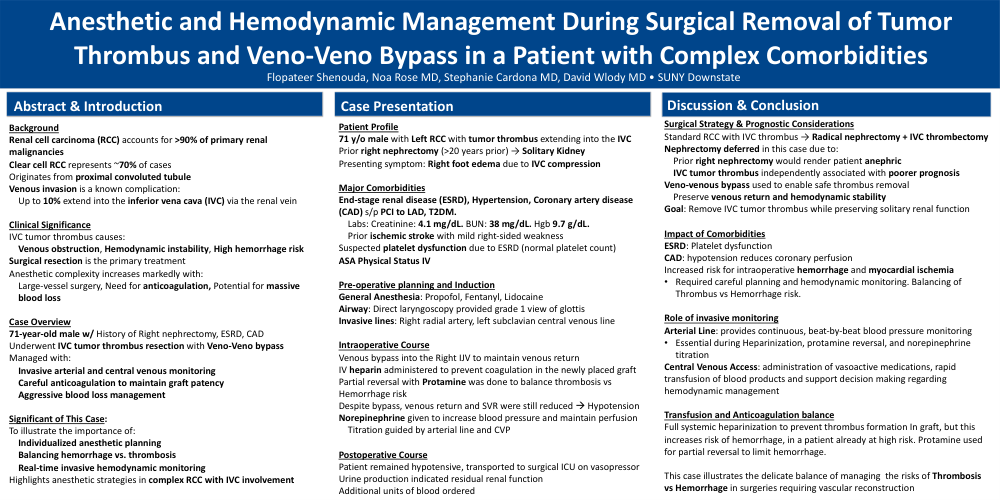
Anesthetic and Hemodynamic Management During Surgical Removal of Tumor Thrombus and Veno-Veno Bypass in a Patient with Complex Comorbidities
Abstract and introduction
Background
Renal cell carcinoma (RCC) accounts for >90% of primary renal malignancies
Clear cell RCC represents ~70% of cases
Originates from proximal convoluted tubule
Venous invasion is a known complication:
Up to 10% extend into the inferior vena cava (IVC) via the renal vein
Clinical Significance
IVC tumor thrombus causes:
Venous obstruction, Hemodynamic instability, High hemorrhage risk
Surgical resection is the primary treatment
Anesthetic complexity increases markedly with:
Large-vessel surgery, Need for anticoagulation, Potential for massive blood loss
Case Overview
71-year-old male w/ History of Right nephrectomy, ESRD, CAD
Underwent IVC tumor thrombus resection with Veno-Veno bypass
Managed with:
Invasive arterial and central venous monitoring
Careful anticoagulation to maintain graft patency
Aggressive blood loss management
Significant of This Case:
To illustrate the importance of:
Individualized anesthetic planning
Balancing hemorrhage vs. thrombosis
Real-time invasive hemodynamic monitoring
Highlights anesthetic strategies in complex RCC with IVC involvement
Case presentation
Patient Profile
71 y/o male with Left RCC with tumor thrombus extending into the IVC
Prior right nephrectomy (>20 years prior) → Solitary Kidney
Presenting symptom: Right foot edema due to IVC compression
Major Comorbidities
End-stage renal disease (ESRD), Hypertension, Coronary artery disease (CAD) s/p PCI to LAD, T2DM.
Labs: Creatinine: 4.1 mg/dL. BUN: 38 mg/dL. Hgb 9.7 g/dL.
Prior ischemic stroke with mild right-sided weakness
Suspected platelet dysfunction due to ESRD (normal platelet count)
ASA Physical Status IV
Pre-operative planning and Induction
General Anesthesia: Propofol, Fentanyl, Lidocaine
Airway: Direct laryngoscopy provided grade 1 view of glottis
Invasive lines: Right radial artery, left subclavian central venous line
Intraoperative Course
Venous bypass into the Right IJV to maintain venous return
IV heparin administered to prevent coagulation in the newly placed graft
Partial reversal with Protamine was done to balance thrombosis vs Hemorrhage risk
Despite bypass, venous return and SVR were still reduced à Hypotension
Norepinephrine given to increase blood pressure and maintain perfusion
Titration guided by arterial line and CVP
Postoperative Course
Patient remained hypotensive, transported to surgical ICU on vasopressor
Urine production indicated residual renal function
Additional units of blood ordered
Disucussion and conclusion
Surgical Strategy & Prognostic Considerations
Standard RCC with IVC thrombus → Radical nephrectomy + IVC thrombectomy
Nephrectomy deferred in this case due to:
Prior right nephrectomy would render patient anephric
IVC tumor thrombus independently associated with poorer prognosis
Veno-venous bypass used to enable safe thrombus removal
Preserve venous return and hemodynamic stability
Goal: Remove IVC tumor thrombus while preserving solitary renal function
ImpactofComorbidities
ESRD: Platelet dysfunction
CAD: hypotension reduces coronary perfusion
Increased risk for intraoperative hemorrhage and myocardial ischemia
Roleofinvasivemonitoring
Arterial Line: provides continuous, beat-by-beat blood pressure monitoring
Central Venous Access: administration of vasoactive medications, rapid transfusion of blood products and support decision making regarding hemodynamic management
Transfusion and Anticoagulation balance
Full systemic heparinization to prevent thrombus formation In graft, but this increases risk of hemorrhage, in a patient already at high risk. Protamine used for partial reversal to limit hemorrhage.
This case illustrates the delicate balance of managing the risks of Thrombosis vs Hemorrhage in surgeries requiring vascular reconstruction