226 posters, 5 topics, 20 sessions, 599 authors, 292 institutions
ePostersLive by SciGen Technologies S.A. All rights reserved.
Obstetric Anaesthesia Annual Scientific Meeting 2026
14-15 May 2026 | Liverpool Convention Centre

7163801
Creating order out of chaos: a quality improvement project evaluating a structured SITREP communication tool during major obstetric haemorrhage
Poster Presenter
Authors
Affiliations
Part of Topic
Quality Improvement
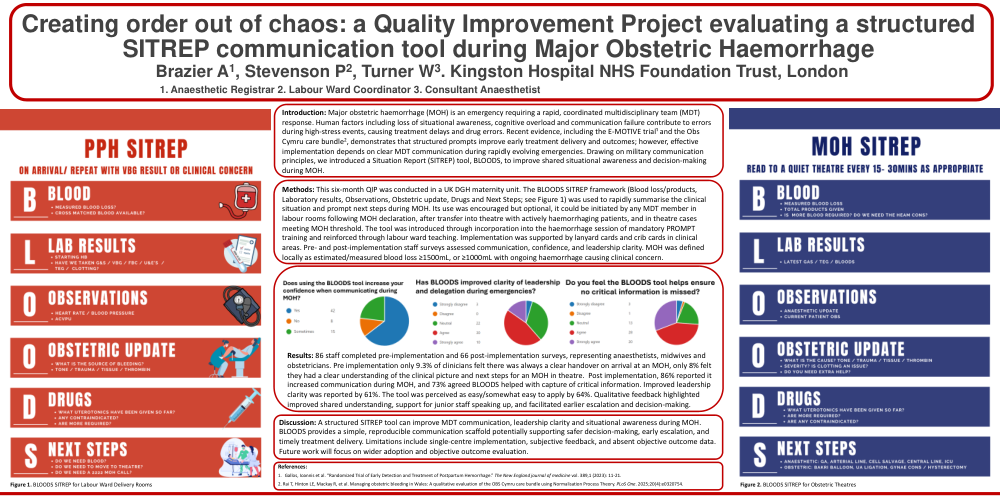
Introduction: Major obstetric haemorrhage (MOH) is an emergency requiring a rapid, coordinated multidisciplinary team (MDT) response. Human factors including loss of situational awareness, cognitive overload and communication failure contribute to errors during high-stress events, causing treatment delays and drug errors. Recent evidence, including the E-MOTIVE trial¹ and the Obs Cymru care bundle2, demonstrates that structured prompts improve early treatment delivery and outcomes; however, effective implementation depends on clear MDT communication during rapidly evolving emergencies. Drawing on military communication principles, we introduced a Situation Report (SITREP) tool, BLOODS, to improve shared situational awareness and decision-making during MOH.
Methods: This six-month QIP was conducted in a UK DGH maternity unit. The BLOODS SITREP framework (Blood loss/products, Laboratory results, Observations, Obstetric update, Drugs and Next Steps; see Figure 1) was used to rapidly summarise the clinical situation and prompt next steps during MOH. Its use was encouraged but optional, it could be initiated by any MDT member in labour rooms following MOH declaration, after transfer into theatre with actively haemorrhaging patients, and in theatre cases meeting MOH threshold. The tool was introduced through incorporation into the haemorrhage session of mandatory PROMPT training and reinforced through labour ward teaching. Implementation was supported by lanyard cards and crib cards in clinical areas. Pre- and post-implementation staff surveys assessed communication, confidence, and leadership clarity. MOH was defined locally as estimated/measured blood loss ≥1500mL, or ≥1000mL with ongoing haemorrhage causing clinical concern.
Results: 86 staff completed pre-implementation and 66 post-implementation surveys, representing anaesthetists, midwives and obstetricians. Pre implementation only 9.3% of clinicians felt there was always a clear handover on arrival at an MOH, only 8% felt they had a clear understanding of the clinical picture and next steps for an MOH in theatre. Post implementation, 86% reported it increased communication during MOH, and 73% agreed BLOODS helped with capture of critical information. Improved leadership clarity was reported by 61%. The tool was perceived as easy/somewhat easy to apply by 64%. Qualitative feedback highlighted improved shared understanding, support for junior staff speaking up, and facilitated earlier escalation and decision-making.
Discussion: A structured SITREP tool can improve MDT communication, leadership clarity and situational awareness during MOH. BLOODS provides a simple, reproducible communication scaffold potentially supporting safer decision-making, early escalation, and timely treatment delivery. Limitations include single-centre implementation, subjective feedback, and absent objective outcome data. Future work will focus on wider adoption and objective outcome evaluation.
References:
2. Rai T, Hinton LE, Mackay R, et al. Managing obstetric bleeding in Wales: A qualitative evaluation of the OBS Cymru care bundle using Normalisation Process Theory. PLoS One. 2025;20(4):e0320754.