226 posters, 5 topics, 20 sessions, 599 authors, 292 institutions
ePostersLive by SciGen Technologies S.A. All rights reserved.
Obstetric Anaesthesia Annual Scientific Meeting 2026
14-15 May 2026 | Liverpool Convention Centre

7162747
Why not Remifentanil PCA? From 'Can we?' to 'We are' in labour analgesia
Part of Topic
Quality Improvement
Why not Remifentanil PCA? From “Can we?” to “We do” in labour analgesia
Muhammed Elgharabawy, Sher Khurram, Priya Sharma, Nitish Updhyay, Mahmoud Elhefnawy
Department of Anaesthesia, Liverpool Women’s Hospital
INTRODUCTION
Labour pain is highly variable, and no single analgesic technique meets all women’s needs. While epidural analgesia remains the gold standard, a substantial proportion of women either decline it or are unable to receive it. At Liverpool Women’s Hospital (LWH), epidural uptake is approximately 25%, meaning that around 75% of women rely on alternative forms of labour analgesia.
Remifentanil patient-controlled analgesia (rPCA) is a recognised alternative, with evidence demonstrating comparable maternal satisfaction and obstetric outcomes. However, its wider adoption has been limited by concerns regarding safety, monitoring requirements, and staff workload.
Historically, at LWH, rPCA utilisation was low, reserved for exceptional circumstances, and often associated with negative staff perceptions.
Aim
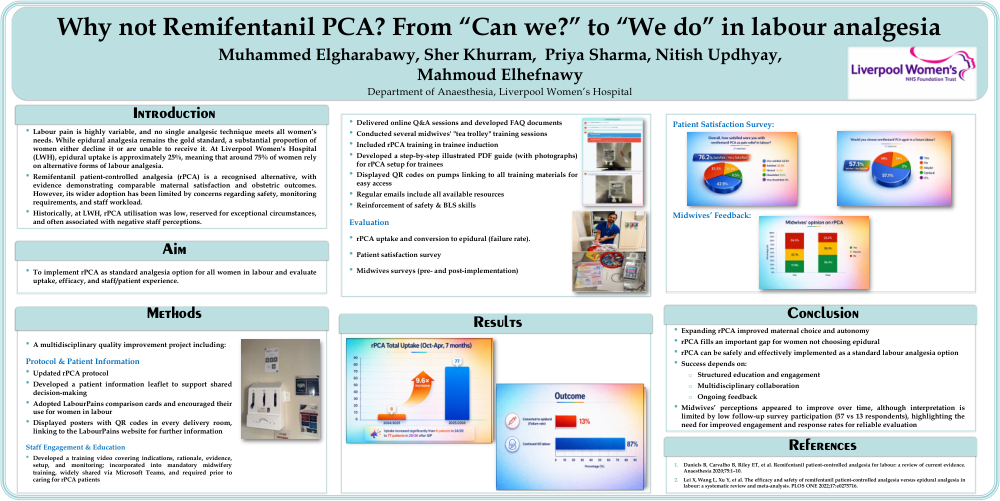
To implement remifentanil PCA as a standard analgesia option for all women in labour and evaluate uptake, efficacy, staff/patient experience.
Methods
A multidisciplinary quality improvement project including:
Protocol & Patient Information
- Updated rPCA protocol
- Developed a patient information leaflet to support shared decision-making
- Adopted LabourPains comparison cards and encouraged their use for women in labour
- Displayed posters with QR codes in every delivery room, linking to the LabourPains website for further information
Staff Engagement & Education
- Developed a training video covering indications, rationale, evidence, setup, and monitoring; incorporated into mandatory midwifery training, widely shared via Microsoft Teams, and required prior to caring for rPCA patients
- Delivered online Q&A sessions and developed FAQ documents
- Conducted several midwives' “tea trolley” training sessions
- Included rPCA training in trainee induction
- Developed a step-by-step illustrated PDF guide (with photographs) for rPCA setup for trainees
- Displayed QR codes on pumps linking to all training materials for easy access
- Regular emails include all available resources
- Reinforcement of safety & BLS skills
Evaluation
- rPCA uptake and conversion to epidural (failure rate)
- Patient satisfaction survey
- Midwife surveys (pre- and post-implementation)
Conclusion
- Expanding rPCA improved maternal choice and autonomy
- rPCA fills an important gap for women not choosing epidural
- rPCA can be safely and effectively implemented as a standard labour analgesia option
- Success depends on:
- Structured education and engagement
- Multidisciplinary collaboration
- Ongoing feedback
- Midwives’ perceptions appeared to improve over time, although interpretation is limited by low follow-up survey participation (57 vs 13 respondents), highlighting the need for improved engagement and response rates for reliable evaluation
References:
- Daniels B, Carvalho B, Riley ET, et al. Remifentanil patient-controlled analgesia for labour: a review of current evidence. Anaesthesia 2020;75:1–10.
- Lei X, Wang L, Xu Y, et al. The efficacy and safety of remifentanil patient-controlled analgesia versus epidural analgesia in labour: a systematic review and meta-analysis. PLOS ONE 2022;17:e0275716.