226 posters, 5 topics, 20 sessions, 599 authors, 292 institutions
ePostersLive by SciGen Technologies S.A. All rights reserved.
Obstetric Anaesthesia Annual Scientific Meeting 2026
14-15 May 2026 | Liverpool Convention Centre

7162684
Improving obstetric anaesthesia training with multidisciplinary maternal medicine simulation
Part of Topic
Quality Improvement
Introduction
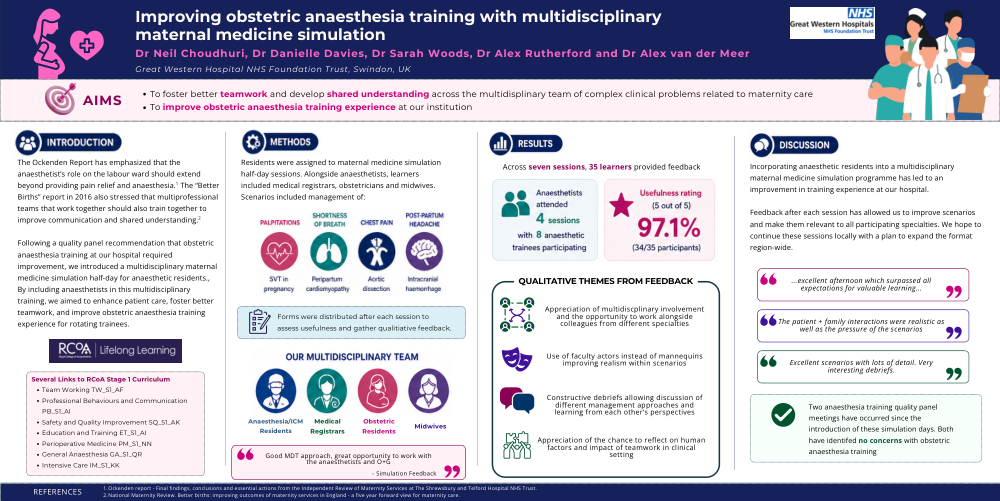
The Ockenden Report has emphasized that the anaesthetist’s role on the labour ward should extend beyond providing pain relief and anaesthesia.1 The “Better Births” report in 2016 stressed that multiprofessional teams that work together should also train together to improve communication and shared understanding.2 Following a quality panel recommendation that obstetric anaesthesia training at our hospital required improvement, we introduced a multidisciplinary maternal medicine simulation half-day for anaesthetic residents. By including anaesthetists in this multidisciplinary training, we aimed to foster better teamwork and improve obstetric anaesthesia training experience for rotating residents.
Methods
Residents were assigned to maternal medicine simulation half-day sessions. Alongside anaesthetists, learners included medical registrars, obstetricians and midwives. Scenarios included management of palpitations (SVT in pregnancy), shortness of breath (peripartum cardiomyopathy), chest pain (aortic dissection) and post-partum headache (intracranial haemorrhage). Forms were distributed after each session to assess usefulness and gather qualitative feedback.
Results
Across seven sessions, 35 learners provided feedback. Anaesthetists attended four sessions, with eight anaesthetic trainees participating. A total of 97.1% (34/35) of participants rated the session’s usefulness as 5 out of 5. Qualitative themes from written feedback included learners appreciating multidisciplinary involvement and the opportunity to work alongside colleagues from different specialties. It also highlighted the usefulness of using faculty actors instead of mannequins to improve realism within the scenarios. The post-scenario debriefs were highlighted as a valuable component, where participants could discuss different management approaches and learn from each other's perspectives. Two quality panel meetings have occurred since the introduction of anaesthetists to these simulation days alongside other interventions and both have identified no concerns with obstetric anaesthesia training at the hospital.
Discussion
Incorporating anaesthetic residents into a multidisciplinary maternal medicine simulation programme has led to an improvement in training experience at our hospital. Feedback after each session allowed us to improve scenarios and make them relevant for all participating specialties. We hope to continue these sessions locally with a plan to expand the format region-wide.