226 posters, 5 topics, 20 sessions, 599 authors, 292 institutions
ePostersLive by SciGen Technologies S.A. All rights reserved.
Obstetric Anaesthesia Annual Scientific Meeting 2026
14-15 May 2026 | Liverpool Convention Centre

7162598
Making simulation stick: overcoming barriers to ward-based MDT simulation in a busy tertiary maternity unit
Poster Presenter
Authors
Affiliations
Part of Topic
Quality Improvement
Making simulation stick: Overcoming barriers to ward-based
MDT simulation in a busy tertiary maternity unit
Dr Flora Kormendy, Dr Harriet Wilson, Dr Abtin Sadeghi, Queen Charlotte`s and Chelsea Hospital. London
Introduction
imulation-based training is integral to developing technical and non-technical skills such as communication, leadership, and teamwork in high-risk obstetric scenarios. The World Health Organization advocates regular multidisciplinary simulation [1], and participation is encouraged by all Royal Colleges.[2] Queens Charlotte`s Hospital is a large tertiary centre for high risk and complex obstetric cases with an average of 5500 deliveries a year. To accommodate simulation in day-to-day practice has many challenges and we would like to share our experiences with this poster.
Method
This project builds on a previous quality improvement initiative demonstrating staff support for regular sessions and the desire to use these 11 priority topics in our ward-based simulation.
Major obstetric haemorrhage
Eclampsia
Local anaesthetic toxicity
Anaphylaxis
Shoulder dystocia
Breech delivery
Diabetic ketoacidosis
High spinal
Maternal cardiac arrest
Cord prolapse
Placental abruption
In collaboration with the educational midwifery team, we delivered monthly MDT real-time simulation sessions on labour ward to maximise authenticity.
Challenges we faced:
1) We agreed that we needed a minimum of two facilitators, one anaesthetist and one educator midwife. Involvement of the practice educator midwifes was
essential to this as they have a more predictable work pattern and established staff relationships.
2) Our first sim had no senior obstetric or midwife participation so following a virtual meeting with the relevant head of services, an email was sent out to encourage participation.
3) We initially had to cancel a sim due to acuity and shortage of staff. Involving the midwife in charge (MIC) early on the day and letting them chose the
location and time helped with this. This dropped the fidelity of the sim but participation was more reliable.
4) This proved challenging due to last-minute educational commitments, fluctuating labour ward acuity and variable team engagement. Future improvement may be achieved through increased facilitator numbers and dedicated anaesthetic staffing for each session.
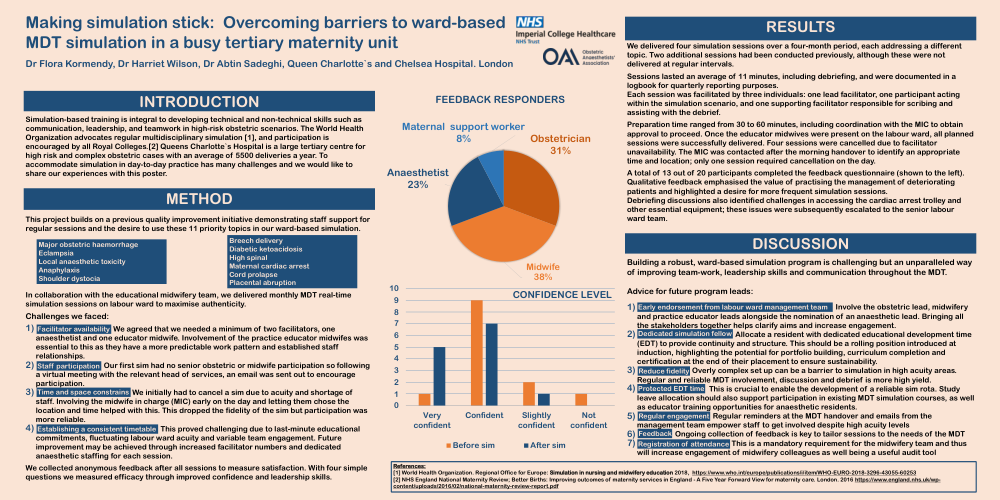
We collected anonymous feedback after all sessions to measure satisfaction. With four simple questions we measured efficacy through improved confidence and leadership skills.
Results
We delivered four simulation sessions over a four-month period, each addressing a different topic. Two additional sessions had been conducted previously, although these were not delivered at regular intervals.
Sessions lasted an average of 11 minutes, including debriefing, and were documented in a logbook for quarterly reporting purposes. Each session was facilitated by three individuals: one lead facilitator, one participant acting within the simulation scenario, and one supporting facilitator responsible for scribing and assisting with the debrief. Preparation time ranged from 30 to 60 minutes, including coordination with the MIC to obtain approval to proceed. Once the educator midwives were present on the labour ward, all planned sessions were successfully delivered. Four sessions were cancelled due to facilitator unavailability. The MIC was contacted after the morning handover to identify an appropriate time and location; only one session required cancellation on the day.
A total of 13 out of 20 participants completed the feedback questionnaire (shown to the left). Qualitative feedback emphasised the value of practising the management of deteriorating patients and highlighted a desire for more frequent simulation sessions. Debriefing discussions also identified challenges in accessing the cardiac arrest trolley and other essential equipment; these issues were subsequently escalated to the senior labour ward team.
Discussion
Building a robust, ward-based simulation program is challenging but an unparalleled way of improving team-work, leadership skills and communication throughout the MDT.
Advice for future program leads:
1) Involve the obstetric lead, midwifery and practice educator leads alongside the nomination of an anaesthetic lead. Bringing all the stakeholders together helps clarify aims and increase engagement.
2) Allocate a resident with dedicated educational development time (EDT) to provide continuity and structure. This should be a rolling position introduced at
induction, highlighting the potential for portfolio building, curriculum completion and certification at the end of their placement to ensure sustainability.
3) Overly complex set up can be a barrier to simulation in high acuity areas. Regular and reliable MDT involvement, discussion and debrief is more high yield.
4) This is crucial to enable the development of a reliable sim rota. Study leave allocation should also support participation in existing MDT simulation courses, as well as educator training opportunities for anaesthetic residents.
5) Regular reminders at the MDT handover and emails from the management team empower staff to get involved despite high acuity levels
6) Ongoing collection of feedback is key to tailor sessions to the needs of the MDT
7) This is a mandatory requirement for the midwifery team and thus will increase engagement of midwifery colleagues as well being a useful audit tool
References
[1] World Health Organization. Regional Office for Europe: Simulation in nursing and midwifery education 2018, https://www.who.int/europe/publications/i/item/WHO-EURO-2018-3296-43055-60253
[2] NHS England National Maternity Review; Better Births: Improving outcomes of maternity services in England - A Five Year Forward View for maternity care. London. 2016 https://www.england.nhs.uk/wp-content/uploads/2016/02/national-maternity-review-report.pdf