226 posters, 5 topics, 20 sessions, 599 authors, 292 institutions
ePostersLive by SciGen Technologies S.A. All rights reserved.
Obstetric Anaesthesia Annual Scientific Meeting 2026
14-15 May 2026 | Liverpool Convention Centre

7161336
Improving documentation in an obstetric high dependency unit
Poster Presenter
Part of Topic
Quality Improvement
Improving documentation in an obstetric high dependency unit
Introduction
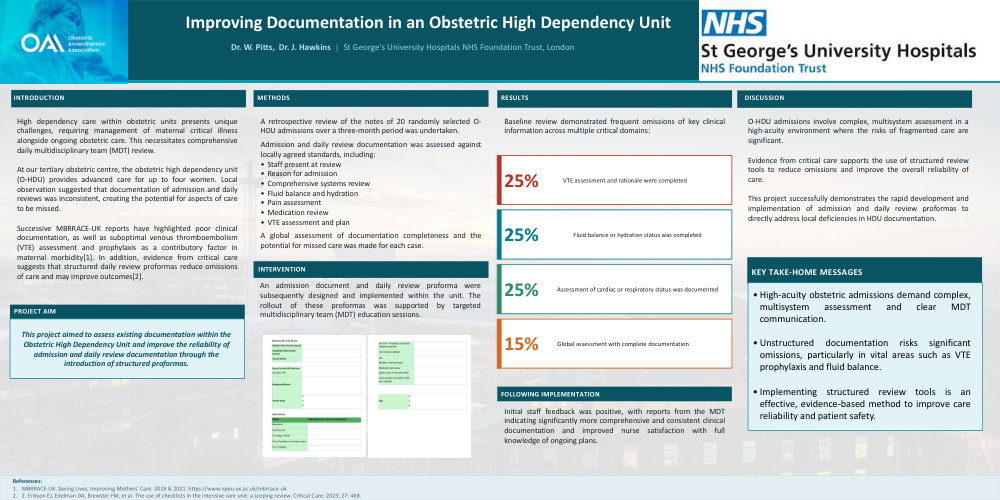
High dependency care within obstetric units presents unique challenges, requiring management of maternal critical illness alongside ongoing obstetric care. This necessitates comprehensive daily multidisciplinary team (MDT) review. At our tertiary obstetric centre, the obstetric high dependency unit (O-HDU) provides advanced care for up to four women. Local observation suggested that documentation of admission and daily reviews was inconsistent, creating the potential for aspects of care to be missed. Successive MBRRACE-UK reports have highlighted poor clinical documentation, as well as suboptimal venous thromboembolism (VTE) assessment and prophylaxis as a contributory factor in maternal morbidity[1]. In addition, evidence from critical care suggests that structured daily review proformas reduce omissions of care and may improve outcomes[2]. This project aimed to assess existing documentation and improve the reliability of admission and daily review documentation through the introduction of structured proformas.
Methods
A retrospective review of the notes of 20 randomly selected O-HDU admissions over a three-month period was undertaken. Admission and daily review documentation was assessed against locally agreed standards, including staff present at review, reason for admission, systems review, fluid balance, pain assessment, medication review, and VTE assessment and plan. A global assessment of documentation completeness and the potential for missed care was made. An admission document and daily review proforma were then designed and implemented, supported by targeted MDT education.
Results
Baseline review demonstrated frequent omissions of key clinical information. VTE assessment and rationale were undocumented in 75% of cases. Fluid balance or hydration status was undocumented in 75% of cases, and assessment of cardiac or respiratory status was absent in 75%. Global assessment found 85% of documentation to be lacking pertinent information. Following implementation, staff feedback was positive, with reports of more comprehensive and consistent documentation.
Discussion
O-HDU admissions involve complex, multisystem assessment in a high-acuity environment. Evidence from critical care supports the use of structured review tools to reduce omissions and improve reliability of care. This project demonstrates the development and implementation of admission and daily review proformas to address deficiencies in documentation within an obstetric HDU.
References
1. MBRRACE-UK. Saving Lives, Improving Mothers’ Care. 2019 and 2021. https://www.npeu.ox.ac.uk/mbrrace-uk
2. Erikson EJ, Edelman DA, Brewster FM, et al. The use of checklists in the intensive care unit: a scoping review. Critical Care. 2023; 27: 468.