226 posters, 5 topics, 20 sessions, 599 authors, 292 institutions
ePostersLive by SciGen Technologies S.A. All rights reserved.
Obstetric Anaesthesia Annual Scientific Meeting 2026
14-15 May 2026 | Liverpool Convention Centre

7161243
Introducing an epidural safety checklist to improve CTG communication on delivery suite
Poster Presenter
Part of Topic
Quality Improvement
Introduction
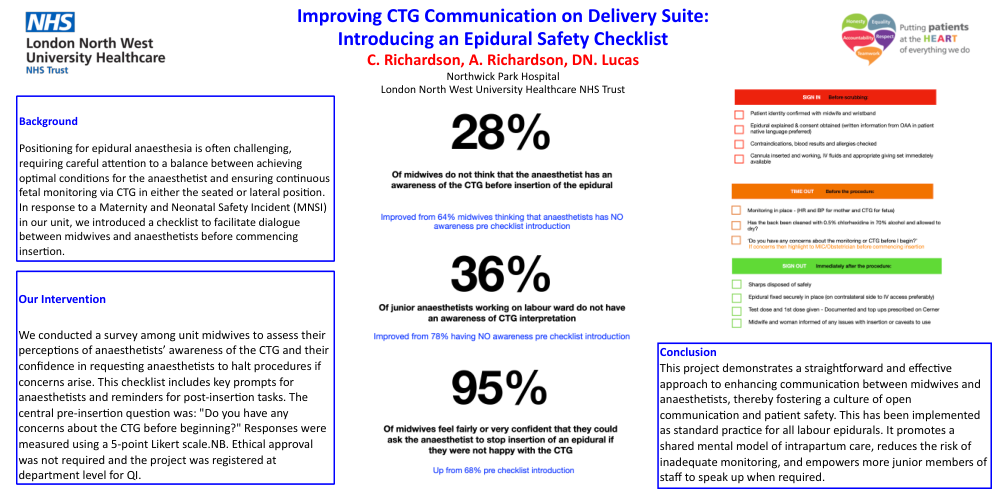
Positioning for epidural anaesthesia is often challenging, requiring careful attention to a balance between achieving optimal conditions for the anaesthetist and ensuring continuous fetal monitoring via CTG in either the seated or lateral position (1). Additionally, junior anaesthetists may be less aware of CTG monitoring, and midwives may feel less confident in requesting that an anaesthetist pause if monitoring is lost or suboptimal. In response to a Maternity and Neonatal Safety Incident (MNSI) in our unit, we introduced a checklist to facilitate dialogue between midwives and anaesthetists before commencing insertion.
Methods
We conducted a survey among unit midwives to assess their perceptions of anaesthetists’ awareness of the CTG and their confidence in requesting anaesthetists to halt procedures if concerns arise. Based on these findings, we developed a concise, three-stage checklist, modelled after the WHO Safe Surgical Checklist, for use before epidural insertion in labour. This checklist includes key prompts for anaesthetists and reminders for post-insertion tasks. The central pre-insertion question was: "Do you have any concerns about the CTG before beginning?" Responses were measured using a 5-point Likert scale.
Results
Before introduction, 68% of midwives feel fairly or very confident that they could ask the anaesthetist to stop insertion of an epidural if they were not happy with the CTG. 64% of midwives in our unit think that anaesthetists do not have an awareness of the CTG when inserting an epidural. After implementation, 100% of junior anaesthetists surveyed were aware of the checklist and found it effective. 95% of midwives now feel fairly or very confident that they could ask the anaesthetist to stop epidural insertion if they were not happy with the CTG, and only 36% now believe that the anaesthetists working in the delivery suite are unaware of the CTG.
Discussion
This project demonstrates a straightforward and effective approach to enhancing communication between midwives and anaesthetists, thereby fostering a culture of open communication and patient safety. This has been implemented as standard practice for all labour epidurals. It promotes a shared mental model of intrapartum care, reduces the risk of inadequate monitoring, and empowers more junior members of staff to speak up when required.