226 posters, 5 topics, 20 sessions, 599 authors, 292 institutions
ePostersLive by SciGen Technologies S.A. All rights reserved.
Obstetric Anaesthesia Annual Scientific Meeting 2026
14-15 May 2026 | Liverpool Convention Centre

7161050
How to fail at quality improvement in obstetric anaesthesia: exploring a project to introduce oral paracetamol for elective LSCS
Poster Presenter
Authors
Affiliations
Part of Topic
Quality Improvement
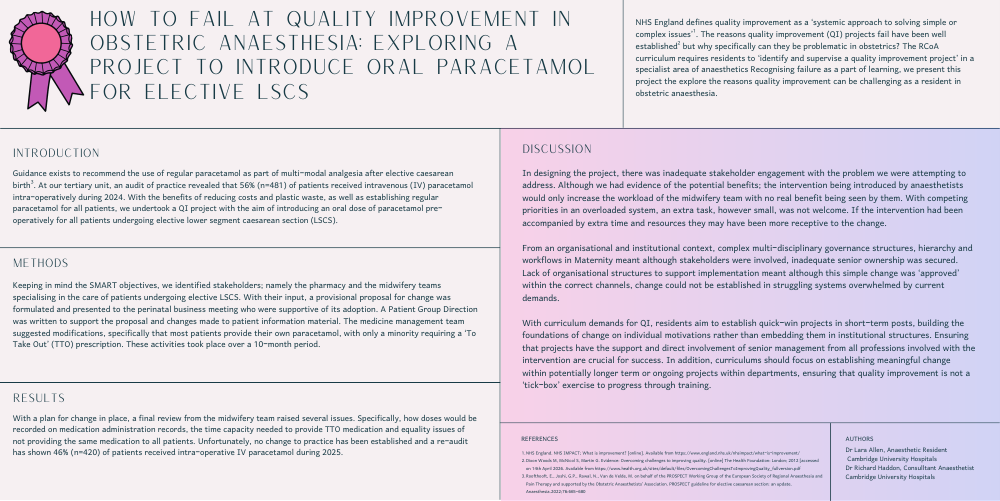
NHS England defines quality improvement as a ‘systemic approach to solving simple or complex issues’1. The reasons quality improvement (QI) projects fail have been well established2 but why specifically can they be problematic in obstetrics? The RCoA curriculum requires residents to ‘identify and supervise a quality improvement project’ in a specialist area of anaesthetics Recognising failure as a part of learning, we present this project the explore the reasons quality improvement can be challenging as a resident in obstetric anaesthesia.
Guidance exists to recommend the use of regular paracetamol as part of multi-modal analgesia after elective caesarean birth3. At our tertiary unit, an audit of practice revealed that 56% (n=481) of patients received intravenous (IV) paracetamol intra-operatively during 2024. With the benefits of reducing costs and plastic waste, as well as establishing regular paracetamol for all patients, we undertook a QI project with the aim of introducing an oral dose of paracetamol pre-operatively for all patients undergoing elective lower segment caesarean section (LSCS).
Keeping in mind the SMART objectives, we identified stakeholders; namely the pharmacy and the midwifery teams specialising in the care of patients undergoing elective LSCS. With their input, a provisional proposal for change was formulated and presented to the perinatal business meeting who were supportive of its adoption. A Patient Group Direction was written to support the proposal and changes made to patient information material. The medicine management team suggested modifications, specifically that most patients provide their own paracetamol, with only a minority requiring a ‘To Take Out’ (TTO) prescription. These activities took place over a 10-month period.
With a plan for change in place, a final review from the midwifery team raised several issues. Specifically, how doses would be recorded on medication administration records, the time capacity needed to provide TTO medication and equality issues of not providing the same medication to all patients. Unfortunately, no change to practice has been established and a re-audit has shown 46% (n=420) of patients received intra-operative IV paracetamol during 2025.
In designing the project, there was inadequate stakeholder engagement with the problem we were attempting to address. Although we had evidence of the potential benefits; the intervention being introduced by anaesthetists would only increase the workload of the midwifery team with no real benefit being seen by them. With competing priorities in an overloaded system, an extra task, however small, was not welcome. If the intervention had been accompanied by extra time and resources they may have been more receptive to the change.
From an organisational and institutional context, complex multi-disciplinary governance structures, hierarchy and workflows in Maternity meant although stakeholders were involved, inadequate senior ownership was secured. Lack of organisational structures to support implementation meant although this simple change was ‘approved’ within the correct channels, change could not be established in struggling systems overwhelmed by current demands.
With curriculum demands for QI, residents aim to establish quick-win projects in short-term posts, building the foundations of change on individual motivations rather than embedding them in institutional structures. Ensuring that projects have the support and direct involvement of senior management from all professions involved with the intervention are crucial for success. In addition, curriculums should focus on establishing meaningful change within potentially longer term or ongoing projects within departments, ensuring that quality improvement is not a ‘tick-box’ exercise to progress through training.