226 posters, 5 topics, 20 sessions, 599 authors, 292 institutions
ePostersLive by SciGen Technologies S.A. All rights reserved.
Obstetric Anaesthesia Annual Scientific Meeting 2026
14-15 May 2026 | Liverpool Convention Centre

7159442
Postpartum neurological complications after neuraxial analgesia: ten year review of MRI spine requests in a tertiary obstetric centre
Poster Presenter
Part of Topic
Quality Improvement
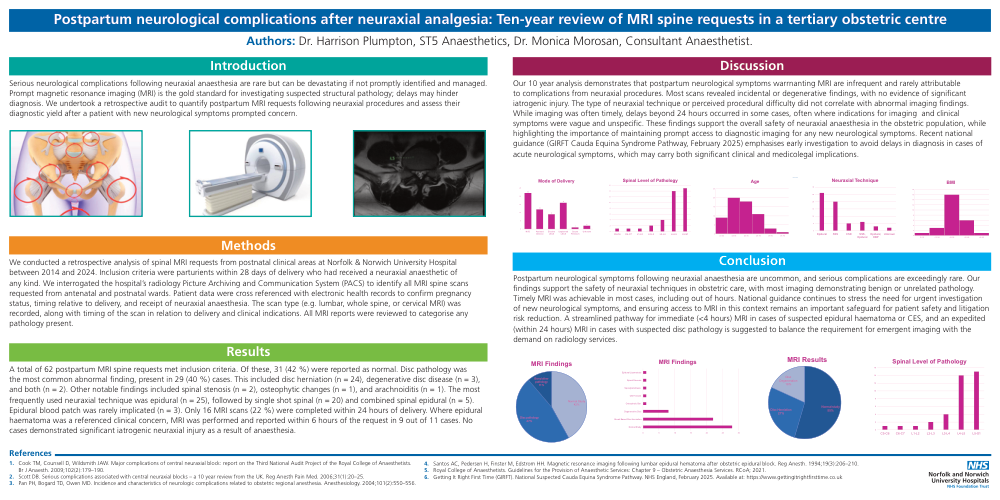
Postpartum neurological complications after neuraxial analgesia: ten‑year review of MRI spine requests in a tertiary obstetric centre
Introduction
Serious neurological complications following neuraxial anaesthesia are rare but can be devastating if not promptly identified and managed. Prompt magnetic resonance imaging (MRI) is the gold standard for investigating suspected structural pathology; delays may hinder diagnosis. We undertook a retrospective audit to quantify postpartum MRI requests following neuraxial procedures and assess their diagnostic yield after a patient with new neurological symptoms prompted concern.
Methods
We conducted a retrospective analysis of spinal MRI requests from postnatal clinical areas at Norfolk & Norwich University Hospital between 2014 and 2024. Inclusion criteria were parturients within 28 days of delivery who had received a neuraxial anaesthetic of any kind. We interrogated the hospital’s radiology Picture Archiving and Communication System (PACS) to identify all MRI spine scans requested from antenatal and postnatal wards. Patient data were cross‑referenced with electronic health records to confirm pregnancy status, timing relative to delivery, and receipt of neuraxial anaesthesia. The scan type (e.g. lumbar, whole spine, or cervical MRI) was recorded, along with timing of the scan in relation to delivery and clinical indications. All MRI reports were reviewed to categorise any pathology present.
Results
A total of 62 postpartum MRI spine requests met inclusion criteria. Of these, 31 (42 %) were reported as normal. Disc pathology was the most common abnormal finding, present in 29 (40 %) cases. This included disc herniation (n = 24), degenerative disc disease (n = 3), and both (n = 2). Other notable findings included spinal stenosis (n = 2), osteophytic changes (n = 1), and arachnoiditis (n = 1). The most frequently used neuraxial technique was epidural (n = 25), followed by single‑shot spinal (n = 20) and combined spinal‑epidural (n = 5). Epidural blood patch was rarely implicated (n = 3). Only 16 MRI scans (22 %) were completed within 24 hours of delivery. Where epidural haematoma was a referenced clinical concern, MRI was performed and reported within 6 hours of the request in 9 out of 11 cases. No cases demonstrated significant iatrogenic neuraxial injury as a result of anaesthesia.
Discussion
Our 10‑year analysis demonstrates that postpartum neurological symptoms warrnanting MRI are infrequent and rarely attributable to complications from neuraxial procedures. Most scans revealed incidental or degenerative findings, with no evidence of significant iatrogenic injury. The type of neuraxial technique or perceived procedural difficulty did not correlate with abnormal imaging findings. While imaging was often timely, delays beyond 24 hours occurred in some cases, often where indications for imaging and clinical symptoms were vague and unspecific. These findings support the overall safety of neuraxial anaesthesia in the obstetric population, while highlighting the importance of maintaining prompt access to diagnostic imaging for any new neurological symptoms. Recent national guidance (GIRFT Cauda Equina Syndrome Pathway, February 2025) emphasises early investigation to avoid delays in diagnosis in cases of acute neurological symptoms, which may carry both significant clinical and medicolegal implications.
Conclusion
Postpartum neurological symptoms following neuraxial anaesthesia are uncommon, and serious complications are exceedingly rare. Our findings support the safety of neuraxial techniques in obstetric care, with most imaging demonstrating benign or unrelated pathology. Timely MRI was achievable in most cases, including out‑of‑hours. National guidance continues to stress the need for urgent investigation of new neurological symptoms, and ensuring access to MRI in this context remains an important safeguard for patient safety and litigation risk reduction. A streamlined pathway for immediate (<4‑hours) MRI in cases of suspected epidural haematoma or CES, and an expedited (within 24‑hours) MRI in cases with suspected disc pathology is suggested to balance the requirement for emergent imaging with the demand on radiology services.
Word Count: 586
References
- Cook TM, Counsell D, Wildsmith JAW. Major complications of central neuraxial block: report on the Third National Audit Project of the Royal College of Anaesthetists. Br J Anaesth. 2009;102(2):179–190.
- Scott DB. Serious complications associated with central neuraxial blocks – a 10‑year review from the UK. Reg Anesth Pain Med. 2006;31(1):20–25.
- Pan PH, Bogard TD, Owen MD. Incidence and characteristics of neurologic complications related to obstetric regional anesthesia. Anesthesiology. 2004;101(2):550–556.
- Santos AC, Pedersen H, Finster M, Edstrom HH. Magnetic resonance imaging following lumbar epidural hematoma after obstetric epidural block. Reg Anesth. 1994;19(3):206–210.
- Royal College of Anaesthetists. Guidelines for the Provision of Anaesthetic Services: Chapter 9 – Obstetric Anaesthesia Services. RCoA; 2021.
- Getting It Right First Time (GIRFT). National Suspected Cauda Equina Syndrome Pathway. NHS England, February 2025. Available at: https://www.gettingitrightfirsttime.co.uk