226 posters, 5 topics, 20 sessions, 599 authors, 292 institutions
ePostersLive by SciGen Technologies S.A. All rights reserved.
Obstetric Anaesthesia Annual Scientific Meeting 2026
14-15 May 2026 | Liverpool Convention Centre

7159218
Secondary analysis of major postpartum haemorrhage thromboprophylaxis timing
Poster Presenter
Part of Topic
Quality Improvement
Secondary analysis of major postpartum haemorrhage thromboprophylaxis timing
Major obstetric haemorrhage rates in Ireland reached 3.4 per 1,000 in 2021, a 58% increase since 2011.Venous thromboembolism (VTE) remains a leading
cause of maternal death (16% of deaths 2020-2022), with two-thirds occurring postpartum. Guidelines recommend thromboprophylaxis with low molecular
weight heparin (LMWH) as soon as haemostasis is achieved after Postpartum haemorrhage (PPH).
Implementation of a standardised timing for
LMWH is complex due to multiple factors such as
neuraxial access (4-hour wait post-spinal/epidural
removal) , surgical haemostasis and potential
coagulopathy and haemodynamic instability,
particularly after major PPH (> 1000ml blood
loss).
Study Design
Retrospective chart review of all
major PPH cases (n=34) over 30
days in a single maternity center.
Data captured: patient
demographics, PPH characteristics,
thromboprophylaxis , neuraxial and
haemostasis timings.
Institution
The Coombe Hospital is a
specialised maternity hospital in
Dublin, established more than
200 years ago. 6506 life births
were recorded in 2024. An
annual audit of PPH rate was
carried out in September 2025
(PPH month).
Objectives
• How timely is LMWH administration after a
major PPH?
• Does measured delay differ by timing anchor:
PPH onset, haemostasis, or earliest safe time?
• Does higher blood loss predict delayed LMWH?
• Where is the potential modifiable delay?
Results
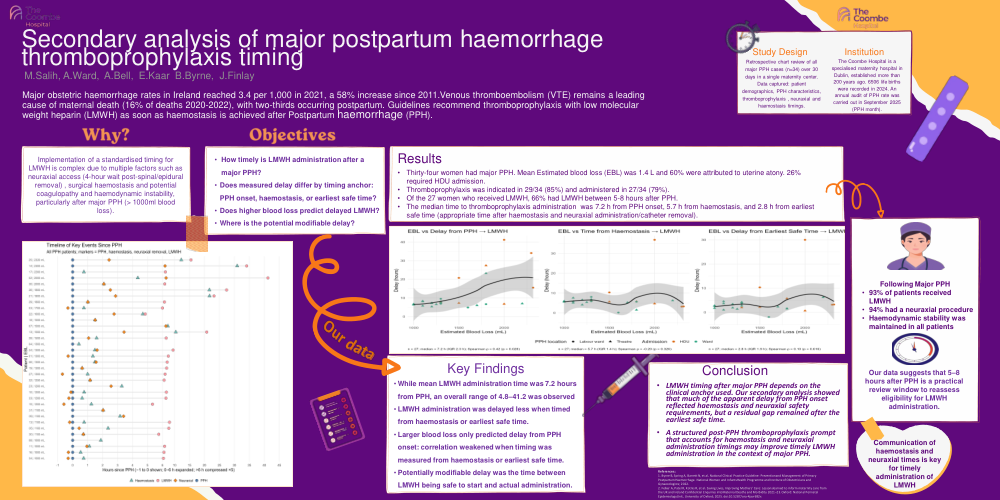
• Thirty-four women had major PPH. Mean Estimated blood loss (EBL) was 1.4 L and 60% were attributed to uterine atony. 26%
required HDU admission.
• Thromboprophylaxis was indicated in 29/34 (85%) and administered in 27/34 (79%).
• Of the 27 women who received LMWH, 66% had LMWH between 5-8 hours after PPH.
• The median time to thromboprophylaxis administration was 7.2 h from PPH onset, 5.7 h from haemostasis, and 2.8 h from earliest
safe time (appropriate time after haemostasis and neuraxial administration/catheter removal).
Our data suggests that 5–8
hours after PPH is a practical
review window to reassess
eligibility for LMWH
administration.
Following Major PPH
• 93% of patients received
LMWH
• 94% had a neuraxial procedure
• Haemodynamic stability was
maintained in all patients
•While mean LMWH administration time was 7.2 hours
from PPH, an overall range of 4.8–41.2 was observed
• LMWH administration was delayed less when timed
from haemostasis or earliest safe time.
• Larger blood loss only predicted delay from PPH
onset: correlation weakened when timing was
measured from haemostasis or earliest safe time.
• Potentially modifiable delay was the time between
LMWH being safe to start and actual administration
Conclusion
• LMWH timing after major PPH depends on the
clinical anchor used. Our secondary analysis showed
that much of the apparent delay from PPH onset
reflected haemostasis and neuraxial safety
requirements, but a residual gap remained after the
earliest safe time.
• A structured post-PPH thromboprophylaxis prompt
that accounts for haemostasis and neuraxial
administration timings may improve timely LMWH
administration in the context of major PPH.
Communication of
haemostasis and
neuraxial times is key
for timely
administration of
LMWH
M.Salih, A.Ward, A.Bell, E.Kaar B.Byrne, J.Finlay
References::
1. Byrne B, Spring A, Barrett N, et al. National Clinical Practice Guideline: Preventionand Management of Primary
Postpartum Haemorrhage. National Women and InfantsHealth Programme and Institute of Obstetricians and
Gynaecologists; 2022.
2. Felker A, Patel R, Kotnis R, et al. Saving Lives, Improving Mothers’ Care: Lessonslearned to inform maternity care from
the UK and Ireland Confidential Enquiries intoMaternal Deaths and Morbidity 2021–23. Oxford: National Perinatal
EpidemiologyUnit, University of Oxford; 2025. doi:10.5287/ora-4javr692x
Our data