226 posters, 5 topics, 20 sessions, 599 authors, 292 institutions
ePostersLive by SciGen Technologies S.A. All rights reserved.
Obstetric Anaesthesia Annual Scientific Meeting 2026
14-15 May 2026 | Liverpool Convention Centre

7158739
User testing of new infographic resources in obstetric regional anaesthesia to improve the maternal consenting process
Part of Topic
Quality Improvement
Introduction
• The 2015 Montgomery vs Lanarkshire Health Board case established that doctors should inform patients of all material risks during the consenting process[1], which is reflected in the latest General Medical Council guidance on decision making and consent[2].
• Unfortunately, it has long been the concern of obstetric anaesthetists that labouring women are given information regarding spinal and epidural anaesthesia in a time-pressured, pain altered environment that can hinder the creation of the conditions required for truly informed consent.
• Concerns regarding this have been frequently expressed, including recently by Nitzani et al. [3], who found that the pain and exhaustion of labour combined with the inadequate and untimely information provided undermined the implementation of informed consent
• These issues are likely only exacerbated in mother’s with lower health literacy, an important consideration as in the UK 7.1 million adults read and write at or below the level of a nine-year-old and 43% of adults do not understand written health information [4]
• There is, therefore, an urgent need to re-examine the informed consent process for neuraxial anaesthesia and analgesia to ensure that labouring mother’s are given the best support when making these complex and important decisions
• To this end the Royal College of Anaesthetists, who are at the forefront of the creation of risk infographics to aid consent discussions, produced 2 new infographics regarding the provision of epidural and spinal anaesthesia, which underwent user testing in the maternity department of a district general hospital
• They were produced in partnership with the Winton Centre for Risk and Evidence Communication, the OAA and have been certified by the Patient Information Forum Trusted Information Creator Kitemark (PIF TICK).
Methods
• 3 questionnaires were created to test the response to the infographics in 3 cohorts: patients; midwives and anaesthetists
• These questionnaires focused on understanding of information, as well as the language used and visual aspect, before giving the chance to add further comments • User testing was carried out over a 3 week period
• Each cohort was given time to examine the relevant resource before being given a bespoke questionnaire collecting information on a number of aspects of the resource
Results
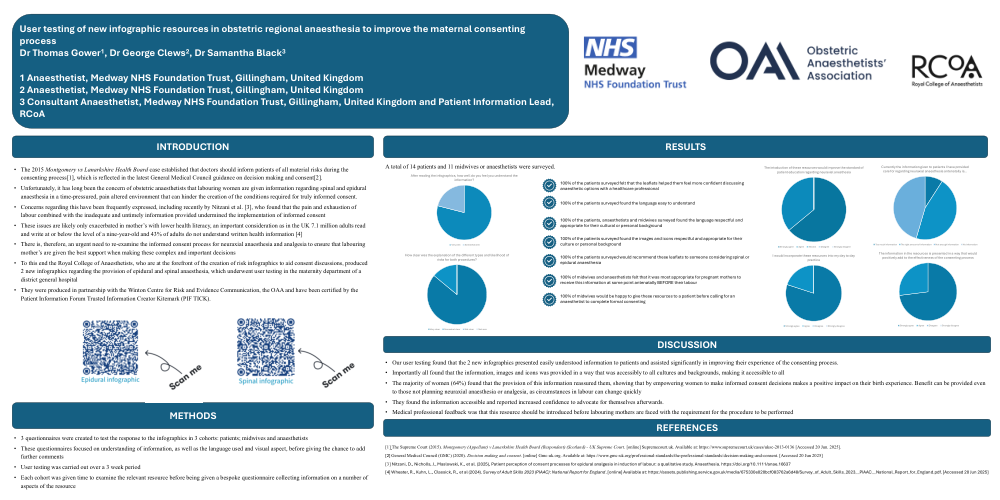
A total of 14 patients and 11 midwives or anaesthetists were surveyed.
100% of the patients surveyed felt that the leaflets helped them feel more confident discussing anaesthetic options with a healthcare professional
100% of the patients surveyed found the language easy to understand
100% of the patients, anaesthetists and midwives surveyed found the language respectful and appropriate for their cultural or personal background
100% of the patients surveyed found the images and icons respectful and appropriate for their culture or personal background 100% of the patients surveyed would recommend these leaflets to someone considering spinal or epidural anaesthesia
100% of midwives and anaesthetists felt that it was most appropriate for pregnant mothers to receive this information at some point antenatally BEFORE their labour
100% of midwives would be happy to give these resources to a patient before calling for an anaesthetist to complete formal consenting
See graphs for further results
Discussion
• Our user testing found that the 2 new infographics presented easily understood information to patients and assisted significantly in improving their experience of the consenting process.
• Importantly all found that the information, images and icons was provided in a way that was accessibly to all cultures and backgrounds, making it accessible to all
• The majority of women (64%) found that the provision of this information reassured them, showing that by empowering women to make informed consent decisions makes a positive impact on their birth experience. Benefit can be provided even to those not planning neuraxial anaesthesia or analgesia, as circumstances in labour can change quickly