226 posters, 5 topics, 20 sessions, 599 authors, 292 institutions
ePostersLive by SciGen Technologies S.A. All rights reserved.
Obstetric Anaesthesia Annual Scientific Meeting 2026
14-15 May 2026 | Liverpool Convention Centre

7158151
Beyond the block; trainee insight and learning after obstetric epidural complications
Poster Presenter
Authors
Affiliations
University Hospital of Wales, Cardiff, University Hospital of Wales
Part of Topic
Surveys
Beyond the block - learning after obstetric epidural complications
E. Rowlands, Y. Metodiev
University Hospital of Wales, Cardiff, Wales
Introduction
Obstetric epidurals improve maternal comfort and facilitate safer management of high-risk parturients but carry recognised risks, such as accidental dural puncture. ¹ ²
Complications are usually managed by consultants with residents often not involved, limiting learning and professional growth.
This project explored anaesthetic residents’ experiences regarding feedback on complications arising from epidurals they had performed.
Methods
Who?
CT1 - ST7 anaesthetic residents and non-training grades across Wales.
How?
Anonymous voluntary survey distributed via email.
What?
Questions on experience, complications, feedback preferences and wellbeing impact.
Governance
Registered survey within the department, did not require formal ethical approval.
Results
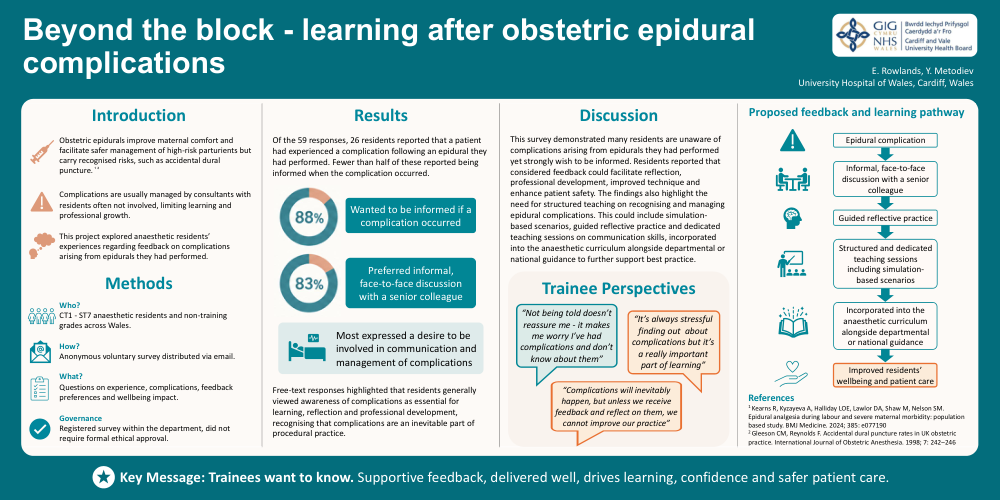
Of the 59 responses, 26 residents reported that a patient had experienced a complication following an epidural they had performed. Fewer than half of these reported being informed when the complication occurred.
88% Wanted to be informed if a complication occurred
83% Preferred informal, face-to-face discussion with a senior colleague
Most expressed a desire to be involved in communication and management of complications
Free-text responses highlighted that residents generally viewed awareness of complications as essential for learning, reflection and professional development, recognising that complications are an inevitable part of procedural practice.
Discussion
This survey demonstrated many residents are unaware of complications arising from epidurals they had performed yet strongly wish to be informed. Residents reported that considered feedback could facilitate reflection, professional development, improved technique and enhance patient safety. The findings also highlight the need for structured teaching on recognising and managing epidural complications. This could include simulation-based scenarios, guided reflective practice and dedicated teaching sessions on communication skills, incorporated into the anaesthetic curriculum alongside departmental or national guidance to further support best practice.
Trainee Perspectives
“Not being told doesn’t reassure me - it makes me worry I’ve had complications and don’t know about them”
“It’s always stressful finding out about complications but it’s a really important part of learning”
“Complications will inevitably happen, but unless we receive feedback and reflect on them, we cannot improve our practice”
Proposed feedback and learning pathway
Epidural complication
Informal, face-to-face discussion with a senior colleague
Guided reflective practice
Structured and dedicated teaching sessions including simulation-based scenarios
Incorporated into the anaesthetic curriculum alongside departmental or national guidance
Improved residents’ wellbeing and patient care
References
1 Kearns R, Kyzayeva A, Halliday LOE, Lawlor DA, Shaw M, Nelson SM. Epidural analgesia during labour and severe maternal morbidity: population based study. BMJ Medicine. 2024; 385: e077190
2 Gleeson CM, Reynolds F. Accidental dural puncture rates in UK obstetric practice. International Journal of Obstetric Anesthesia. 1998; 7: 242–246