226 posters, 5 topics, 20 sessions, 599 authors, 292 institutions
ePostersLive by SciGen Technologies S.A. All rights reserved.
Obstetric Anaesthesia Annual Scientific Meeting 2026
14-15 May 2026 | Liverpool Convention Centre

7158128
Placenta accreta spectrum: data review of PAS cases in an Italian tertiary level unit successfully managed by multidisciplinary team care
Part of Topic
Quality Improvement
PLACENTA ACCRETA SPECTRUM: DATA REVIEW OF PAS CASES IN AN ITALIAN TERTIARY LEVEL UNIT SUCCESSFULLY MANAGED BY MULTIDISCIPLINARY TEAM CARE
T.Palladino 1, P.Ricciardi 2, S. Mariotti 2, G. Ciccarese 3, P. Vaira 1, A. Maglione 2
1 Dipartimento di Emergenza, Primo Servizio di Anestesia E Rianimazione, IRCCS Casa Sollievo della Sofferenza, San Giovanni Rotondo, Italy;
2 Unità Operativa Complessa di Ginecologia e Ostetricia, IRCCS Casa Sollievo della Sofferenza, San Giovanni Rotondo, Italy;
3 Unità di Radiologia Interventistica, IRCCS Casa Sollievo della Sofferenza, San Giovanni Rotondo, Italy.
AFFILIATION
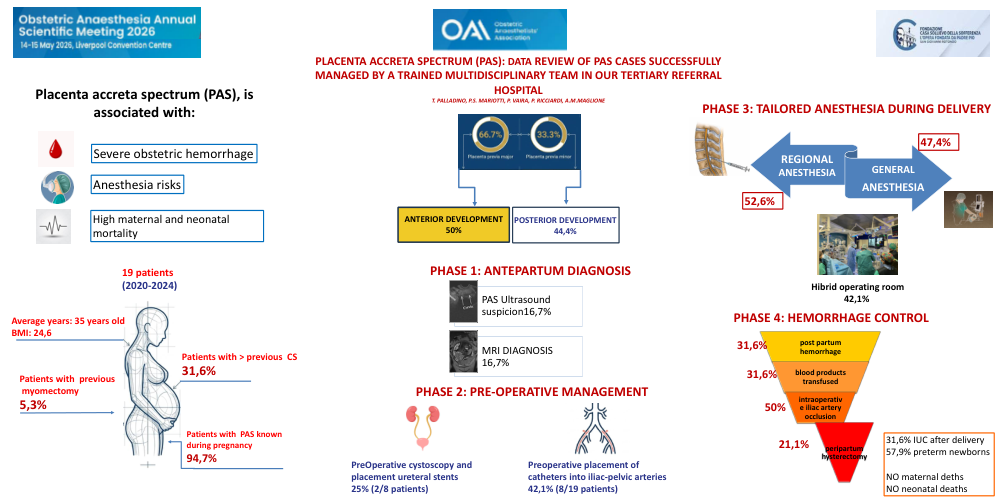
INTRODUCTION Placenta accreta spectrum is frequently associated with severe obstetric haemorrhage and high mortality. We present data review of PAS cases successfully managed by a comprehensive multidisciplinary team care accustomed to the management of PAS in an Italian Tertiary Level Unit.
MATERIALS AND METHODS This analysis includes all PAS cases which have been managed between 2020 and 1st semester of 2024 at Casa Sollievo della Sofferenza CSS.
RESULTS During the study period, 19 women underwent Caesarean Section for PAS reason. More than half women were preterm at time of delivery and almost 100% had almost one previous CS in their obstetric history. Regarding Obstetric management during pregnancy, 66.7% were placenta praevia major cases. MRI was performed in 3 cases. Regarding Multidisciplinary management at time of delivery, almost half CS were performed in Hybrid Operating Room; more than half were conducted under Regional Anaesthesia and for all of them interventional radiologic procedures with preoperative placement of catheters were carried out; iliac arteries occlusion was necessary for half of them. Ureteral stents were placed in 2 cases. Peripartum Hysterectomy was performed in 4 cases and one third of them were admitted to the ICU. More than half newborns were admitted to the NICU. No maternal or neonatal deaths occurred.
CONCLUSIONS CSS has developed an internal protocol for managing PAS cases. We presented our cases successfully managed by multidisciplinary team, composed of Gynaecologists, Obstetricians, Sonographers, Anaesthesiologists, Urologists and Interventional Radiologists. A careful antepartum diagnosis by ultrasound imaging is critical to get ready for surgery; surgical and anaesthetic skills are significant to reduce risk of injury; interventional radiologic technique is fundamental to minimise high risk of intraoperative haemorrhage. These skilled facilities are fundamental for optimal management of these increasingly frequent cases.
Table 1 MATERNAL FEATURES
|
TOTAL |
19 Patients |
|
|
AGE |
35 ys |
|
|
BMI |
24,6 |
|
|
ART |
4/19 |
21.1% |
|
≥ 1 previous CS |
6/19 |
31.6% |
|
PAS known during pregnancy |
18/19 |
94.7% |
|
Previous myomectomy |
1/19 |
5.3% |
|
Gestational age at delivery < 37ws (30ws+1d – 36ws+5ds) |
11/19 |
57.9% |
Table 2 MANAGEMENT DURING PREGNANCY
|
PAS known during pregnancy |
18/19 |
94.7% |
|
Placenta praevia major |
12/18 |
66.7% |
|
Placenta praevia minor |
6/18 |
33.3% |
|
Anterior development |
9/18 |
50% |
|
Posterior development |
8/18 |
44.4% |
|
PAS Ultrasound suspicion |
3/18 |
16.7% |
|
MRI during pregnancy |
3/18 |
16.7% |
Table 3 MULTIDISCIPLINARY MANAGEMENT AT DELIVERY
|
Hybrid Operating Room |
8/19 |
42.1% |
|
Regional Anaesthesia |
10/19 |
52.6% |
|
General Anaesthesia |
9/19 |
47.4% |
|
Interventional Radiologic Procedure (preoperative placement of catheters into iliac pelvic arteries) |
8/19 |
42.1% |
|
Iliac arteries occlusion |
4/8 (average 12’) |
50% |
|
Preoperative cystoscopy and placement of ureteral stents |
2/8 |
25% |
|
Post partum Haemorrhage ≥ 1000mL |
6/19 |
31.6% |
|
Peripartum Hysterectomy |
4/19 |
21.1% |
|
Blood products transfusion |
6/19 |
31.6% |
|
IV iron therapy |
8/19 |
42.1% |
|
ICU |
6/19 |
31.6% |
|
Histological assessment |
13/19 |
68.4% |
Table 4 NEONATAL OUTCOME
|
BIRTH WEIGHT |
2743 gr |
|
|
Apgar 5’ |
8 |
|
|
Umbilical Artery pH |
7.29 |
|
|
Umbilical Vein pH |
7.33 |
|
|
UTIN |
11/19 |
57.9% |