226 posters, 5 topics, 20 sessions, 599 authors, 292 institutions
ePostersLive by SciGen Technologies S.A. All rights reserved.
Obstetric Anaesthesia Annual Scientific Meeting 2026
14-15 May 2026 | Liverpool Convention Centre

7157215
Improving preparedness for obstetric airway emergencies: integrating simulation training into a local induction programme
Poster Presenter
Authors
Affiliations
Part of Topic
Quality Improvement
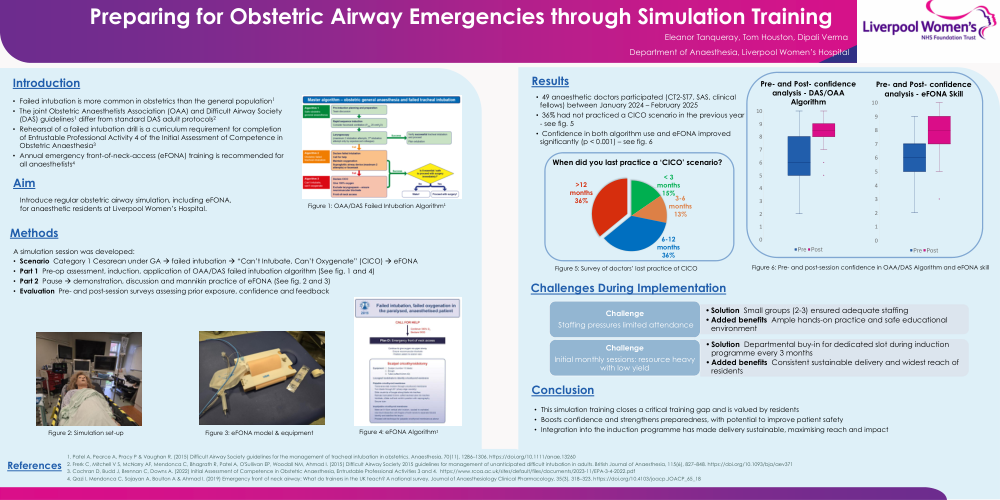
Preparing for Obstetric Airway Emergencies through Simulation Training
Eleanor Tanqueray, Tom Houston, Dipali Verma
Department of Anaesthesia, Liverpool Women's Hospital
Introduction:
Aim:
Introduce regular obstetric airway simulation, including eFONA, for anaesthetic residents at Liverpool Women’s Hospital.
Methods:
A simulation session was developed:
Reults:
Challenges during implementation:
Challenge: Staffing pressures limited attendance
Conclusion:
• This simulation training closes a critical training gap and is valued by residents
• Boosts confidence and strengthens preparedness, with potential to improve patient safety
• Integration into the induction programme has made delivery sustainable, maximising reach and impact
References:
1. Patel A, Pearce A, Pracy P & Vaughan R. (2015) Difficult Airway Society guidelines for the management of tracheal intubation in obstetrics. Anaesthesia, 70(11), 1286–1306. https://doi.org/10.1111/anae.13260
2. Frerk C, Mitchell V S, McNarry AF, Mendonca C, Bhagrath R, Patel A, O'Sullivan EP, Woodall NM, Ahmad I. (2015) Difficult Airway Society 2015 guidelines for management of unanticipated difficult intubation in adults. British Journal of Anaesthesia, 115(6), 827–848. https://doi.org/10.1093/bja/aev371
3. Cochran D, Budd J, Brennan C, Downs A. (2022) Initial Assessment of Competence in Obstetric Anaesthesia, Entrustable Professional Activities 3 and 4. https://www.rcoa.ac.uk/sites/default/files/documents/2023-11/EPA-3-4-2022.pdf
4. Qazi I, Mendonca C, Sajayan A, Boulton A & Ahmad I. (2019) Emergency front of neck airway: What do trainers in the UK teach? A national survey. Journal of Anaesthesiology Clinical Pharmacology, 35(3), 318–323. https://doi.org/10.4103/joacp.JOACP_65_18