150 posters, 16 sessions, 294 authors, 70 institutions
ePostersLive by SciGen Technologies S.A. All rights reserved.
Obstetric Anaesthesia Annual Scientific Meeting 2024
Thursday 9 - Friday 10 May 2024, Birmingham

6302061
Obstetric patient's perspectives on the pre-operative consent process, incidence of intraoperative pain, its management and overall satisfaction.
Poster Presenter
Authors
Affiliations
Part of Topic
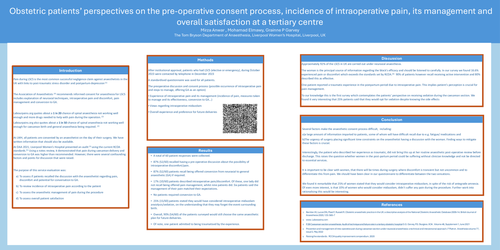
Obstetric patients’ perspectives on the pre-operative consent process, incidence of intraoperative pain, its management and overall satisfaction at a tertiary centre .
Mirza Anwar , Mohamad Elmawy, Grainne P Garvey
The Tom Bryson Department of Anaesthesia, Liverpool Women’s Hospital, Liverpool, UK .
Introduction:
Pain during LSCS is the most common successful negligence claim against anaesthetists in the UK with links to post-traumatic stress disorder and postpartum depression.(1) The Association of Anaesthetists (4) recommends informed consent for anaesthesia for LSCS includes explanation of neuraxial techniques, intraoperative pain and discomfort, pain management and conversion to GA. Labourpains.org quotes about a 1 in 20 chance of spinal anaesthesia not working well enough and more drugs needed to help with pain during the operation. (2) Labourpains.org also quotes about a 1 in 50 chance of spinal anaesthesia not working well enough for caesarean birth and general anaesthesia being required. (2) At LWH, all patients are consented by an anaesthetist on the day of their surgery. We have written information that should also be available. At OAA 2021, Liverpool Women’s Hospital presented an audit (3) using the current RCOA standards.(5) Using a notes review, it demonstrated that pain during caesarean delivery and conversion to GA was higher than recommended. However, there were several confounding factors and points for discussion that were raised. The purpose of this service evaluation was: a) To assess if patients recalled the discussion with the anaesthetist regarding pain, discomfort and potential for conversation to GA. b)To review incidence of intraoperative pain according to the patient c) To assess the anaesthetic management of pain during the procedure d)To assess overall patient satisfaction.
Methods:
After institutional approval, patients who had LSCS (elective or emergency), during October 2023 were contacted by telephonein December 2023 A standardised questionnaire was used for all patients. The preoperative discussion and consent process (possible occurrence of intraoperative pain and steps to manage, offering GA as an option) • Experience of intraoperative pain and its management (incidence of pain, measures taken to manage and its effectiveness, conversion to GA…) • Views regarding intraoperative midazolam • Overall experience and preference for future deliveries.
Results:
• A total of 60 patient responses were collected. • 87% (52/60) recalled having a pre-operative discussion about the possibility of intraoperative discomfort/pain. • 87% (52/60) patients recall being offered conversion from neuraxial to general anaesthetic (GA) if required. • 17% (10/60) patients described intraoperative pain/discomfort. Of these, one lady did not recall being offered pain management, whilst nine patients did. Six patients said the management of their pain matched their expectations. • No patients required conversion to GA. • 25% (15/60) patients stated they would have considered intraoperative midazolam anxiolysis/sedation, on the understanding that they may forget the event surrounding birth. • Overall, 90% (54/60) of the patients surveyed would still choose the same anaesthetic plan for future deliveries. • Of note, one patient admitted to being traumatised by the experience.
Discussion.
Approximately 92% of the LSCS in UK are carried out under neuraxial anaesthesia. The woman is the principal source of information regarding the block's efficacy and should be listened to carefully. In our survey we found 16.6% experienced pain or discomfort which exceeds the standards set by RCOA.(6) 90% of patients however recall receiving active intervention and 80% described this as effective. One patient reported a traumatic experience in the postpartum period due to intraoperative pain. This implies patient’s perception is crucial for pain management. To our knowledge this is the first survey which contemplates the patients’ perspective on receiving sedation during the caesarean section. We found it very interesting that 25% patients said that they would opt for sedation despite knowing the side effects.
Conclusion:
Several factors make the anaesthetic consent process difficult, including: a)a large amount of information imparted to patients, some of whom will have difficult recall due to e.g. fatigue/ medications and b)The urgency of surgery placing significant time constraints on the anaesthetist having a discussion with the woman. Finding ways to mitigate these factors is crucial. Interestingly, the patient who described her experience as traumatic, did not bring this up at her routine anaesthetic post-operative review before discharge. This raises the question whether women in the post-partum period could be suffering without clinician knowledge and not be directed to essential services. It is important to be clear with women, that there will be times during surgery where discomfort is transient but not uncommon and to differentiate this from pain. We should have been clear in our questionnaire to differentiate between the two sensations. We found it remarkable that 25% of women stated that they would consider intraoperative midazolam, in spite of the risk of antegrade amnesia. Of even more interest, is that 10% of women who would consider midazolam, didn’t suffer any pain during the procedure. Further work into rationalising this would be interesting.
Refrences:
1.Bamber JH,Lucas DN,Plaat F,Russell R.Obstetric anaesthetic practice in the UK: a descriptive analysis of the National Obstetric Anaesthetic Database 2009–14.British Journal of Anaesthesia2020;125:580–7 .
2) www. Laborpains.com
3) P.39 Caesarean section anaesthesia: Audit of technique and failure rate in a tertiary obstetric hospital G.G. Garvey, P.S. Sturgess. IJOA . Volume 46, Supplement 1, June 2021.
4) Prevention and management of intra-operative pain during caesarean section under neuraxial anaesthesia: a technical and interpersonal approach. F Platt et . Anesthesia volume 77, issue 5. May 2022 5) Raising the standards : RCOA quality improvement compendium. 2020.