150 posters, 16 sessions, 294 authors, 70 institutions
ePostersLive by SciGen Technologies S.A. All rights reserved.
Obstetric Anaesthesia Annual Scientific Meeting 2024
Thursday 9 - Friday 10 May 2024, Birmingham

6248797
Spinal anaesthesia for Caesarean delivery in a patient with severe Factor VII deficiency
Poster Presenter
Authors
Affiliations
Part of Topic
•Factor VII (FVII) is required for normal coagulation within the extrinsic pathway with normal values of 31-100 iu/dL. Upon vessel injury it binds to tissue factor (TF) and becomes activated to FVIIa by various proteases. The TF/FVIIa complex catalyses conversion of FIX and FX into active proteases within the common pathway.
•Deficiency of this factor is caused by defects in the FVII gene with an incidence of around 1:500,000(1). Those with severe disease (FVII level of <10iu/dL) can present with a catastrophic haemorrhage during pregnancy and at the time of delivery(2).
Background
•A 26-year multiparous parturient with homozygous mutation causing severe FVII deficiency with a baseline assay of <1iu/dL required antenatal assessment in the multi-disciplinary team (MDT) haematology/obstetric/anaesthetic clinic.
•Initial diagnosis was made following severe bleeding after an elective cholecystectomy.
•Previous caesarean birth with FVII cover under GA was performed without haemorrhage.
Delivery plan
•Rotational forceps and ventouse delivery were contraindicated due to the risk of intracranial bleeding in the heterozygous neonate.
•The agreed birth plan, as preferred by the patient, was an elective caesarean section under regional anaesthesia with FVII replacement.
Birth
•Unexpectedly, she presented in premature labour requiring category 3 caesarean section.
•The planned FVII replacement regime was commenced. Once levels were adequate, the caesarean section was performed under spinal anaesthesia with a blood loss of 360mL.
•FVII infusion was continued for five days postoperatively before discharge.
Factor VII Regime
Loading dose (8.5mcg/kg)
•Initial bolus should be administered at the onset of spontaneous labour and prior to elective or emergency birth (0.7mg for our 85kg patient).
Maintenance infusion (0.9mcg/kg/hr)
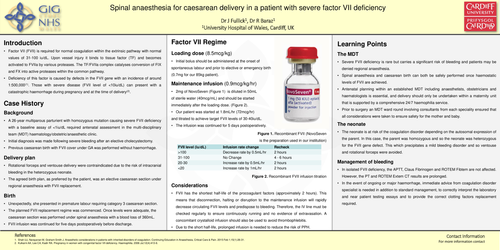
•2mg of NovoSeven (Figure 1) is diluted in 50mL of sterile water (40mcg/mL) and should be started immediately after the loading dose. (Figure 2).
•Our patient was started at 1.8mL/hr (72mcg/hr) and titrated to achieve target FVII levels of 30-40iu/dL.
•The infusion was continued for 5 days postoperatively.
Considerations
•FVII has the shortest half-life of the procoagulant factors (approximately 2 hours). This means that disconnection, halting or disruption to the maintenance infusion will rapidly decrease circulating FVII levels and predispose to bleeding. Therefore, the IV line must be checked regularly to ensure continuously running and no evidence of extravasation. A concomitant crystalloid infusion should also be used to avoid thrombophlebitis.
•Due to the short half-life, prolonged infusion is needed to reduce the risk of PPH.
The MDT
•Severe FVII deficiency is rare but carries a significant risk of bleeding and patients may be denied regional anaesthesia.
•Spinal anaesthesia and caesarean birth can both be safely performed once haemostatic levels of FVII are achieved.
•Antenatal planning within an established MDT including anaesthetists, obstetricians and haematologists is essential, and delivery should only be undertaken within a maternity unit that is supported by a comprehensive 24/7 haemophilia service.
•Prior to surgery an MDT ward round involving consultants from each speciality ensured that all considerations were taken to ensure safety for the mother and baby.
The neonate
•The neonate is at risk of the coagulation disorder depending on the autosomal expression of the parent. In this case, the parent was homozygous and so the neonate was heterozygous for the FVII gene defect. This which precipitates a mild bleeding disorder and so ventouse and rotational forceps were avoided.
Management of bleeding
•In isolated FVII deficiency, the APTT, Claus Fibrinogen and ROTEM Fibtem are not affected. However, the PT and ROTEM Extem CT results are prolonged.
•In the event of ongoing or major haemorrhage, immediate advice from coagulation disorder specialist is needed in addition to standard management, to correctly interpret the laboratory and near patient testing essays and to provide the correct clotting factors replacement required.