Loading...

150 posters, 16 sessions, 294 authors, 70 institutions

ePostersLive by SciGen Technologies S.A. All rights reserved.

Obstetric Anaesthesia Annual Scientific Meeting 2024

Thursday 9 - Friday 10 May 2024, Birmingham

Obstetric Anaesthesia Annual Scientific Meeting 2024 banner

6299171

Peripartum care of a patient with severe left ventricular dysfunction diagnosed following COVID-19 infection.
Part of Topic

Peripartum care of a patient with severe left ventricular dysfunction diagnosed following COVID-19 infection

Introduction

Cardiomyopathy during pregnancy presents significant challenges for the multidisciplinary team (MDT) in maternal medicine centres. We describe a case of dilated cardiomyopathy with severe left ventricular (LV) dysfunction diagnosed following COVID-19 infection.

Antepartum

•41 year old gravida 4 para 3 – previous uneventful pregnancies with spontaneous vaginal deliveries.
•Past medical history – nil of note.
•Presented at 24 weeks gestation with COVID-19 pneumonitis complicated by  severe LV dysfunction. 
•She was transferred to a cardiac centre for further investigation and treatment.
•Transthoracic echo (TTE) revealed a severely dilated LV with severely impaired function (EF 20-25%) with moderate mitral regurgitation. 
•COVID myocarditis was considered, however diagnostic criteria were not met, and MRI did not support this diagnosis. 
•She was discharged on medical treatment and anticoagulation, for follow up by the maternal cardiac MDT.
•At 30  weeks, TTE showed severe biventricular dysfunction. A delivery plan was made by the maternal cardiac MDT for both caesarean section and spontaneous vaginal delivery.

Intrapartum
 
•Delivery was by elective caesarean section at 36 weeks gestation.
•She was admitted one day prior to her caesarean section for pre-optimisation.
•Peripheral and central venous access were obtained.
•Arterial line was inserted for invasive blood pressure and cardiac output monitoring 
•Combined spinal-epidural was performed.
•Spinal component – 5mg heavy bupivacaine plus diamorphine.
•Epidural top up – 20ml ‘fast mix’ in slow increments.
•Bloop pressure was maintained with noradrenaline up to a dose of 0.1mcg/kg/minute.
•Oxytocin was given via the cardiac oxytocin regime.
•The caesarean section was uncomplicated, with an estimated blood loss of 530ml.
 
Postpartum
 
•After delivery she was admitted to intensive care unit for weaning of inotropic support, close observation, and fluid balance management. Noradrenaline was weaned and an even to negative 500ml fluid balance was maintained.
•TTE prior to discharge showed severely impaired LV function (EF 20-25%) with severe mitral regurgitation and right ventricular impairment.
•She was discharged day seven post-deliverywith a plan for follow up in the ObstetricCardiac clinic in two weeks.
•
•Day 13 post-delivery she was admitted with an acute decompensation, hypotension and acute kidney injury secondary to E. coli sepsis. She was admitted to a cardiac intensive care unit and was stabilised with antibiotics and inotropic support. 
•She is now followed up by the heart failure team and her most recent TTE showed some improvement in LV function on standard heart failure therapy (LVEF 42%).
•She has been referred for a cardiomyopathy genetic screen.
 

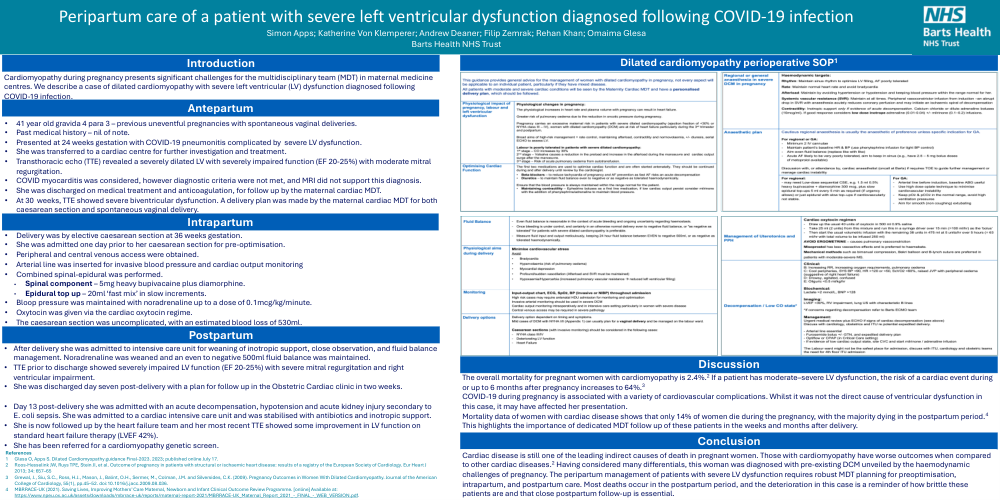
Dilated cardiomyopathy perioperative SOP1

Discussion

The overall mortality for pregnant women with cardiomyopathy is 2.4%.2 If a patient has moderate–severe LV dysfunction, the risk of a cardiac event during or up to 6 months after pregnancy increases to 64%.3

COVID-19 during pregnancy is associated with a variety of cardiovascular complications. Whilst it was not the direct cause of ventricular dysfunction in this case, it may have affected her presentation.

Mortality data of women with cardiac disease shows that only 14% of women die during the pregnancy, with the majority dying in the postpartum period.4 This highlights the importance of dedicated MDT follow up of these patients in the weeks and months after delivery.

Conclusion

Cardiac disease is still one of the leading indirect causes of death in pregnant women. Those with cardiomyopathy have worse outcomes when compared to other cardiac diseases.2 Having considered many differentials, this woman was diagnosed with pre-existing DCM unveiled by the haemodynamic challenges of pregnancy. The peripartum management of patients with severe LV dysfunction requires robust MDT planning for preoptimisation, intrapartum, and postpartum care. Most deaths occur in the postpartum period, and the deterioration in this case is a reminder of how brittle these patients are and that close postpartum follow-up is essential.

Obstetric Anaesthesia Annual Scientific Meeting 2024 » banner
Copyright © 2015-2026, ePostersLive® SciGen is a registered trademark of SciGen Technologies S.A. Patent pending.

This website and third-party tools we use rely on cookies for the best user experience. By selecting "I agree", you agree to cookie usage as described in our Privacy Policy.