150 posters, 16 sessions, 294 authors, 70 institutions
ePostersLive by SciGen Technologies S.A. All rights reserved.
Obstetric Anaesthesia Annual Scientific Meeting 2024
Thursday 9 - Friday 10 May 2024, Birmingham

6289714
Are we checking epidural catheter placement effectively?
Poster Presenter
Authors
Part of Topic
Are we checking epidural catheter placement effectively?
Introduction
Epidurals are commonly used in labour
Anaesthetists need to be confident epidural catheters are correctly placed to avoid potential harm from intravascular or intrathecal injection
Methods to check position include:
• Pharmacological tests e.g. test dose
• Non-pharmacological e.g. meniscus test and catheter aspiration
Recommended method to perform non-pharmacological tests:
• Aspiration:
➢ Pull back syringe plunger 2-3ml
• Meniscus test:
➢ Step 1 – raise catheter tip 30cm above insertion point and look for dropping meniscus
➢ Step 2 – lower catheter tip 30cm below insertion point and look for meniscus moving and catheter filling with clear fluid, not blood
Aim
To determine how many anaesthetists are using non-pharmacological methods to check epidural catheter placement and if they are being used appropriately
Method
Electronic survey sent to all anaesthetists at East Surrey Hospital
Questions included asking which methods they used to check epidural catheter placement and how they performed these methods
Results
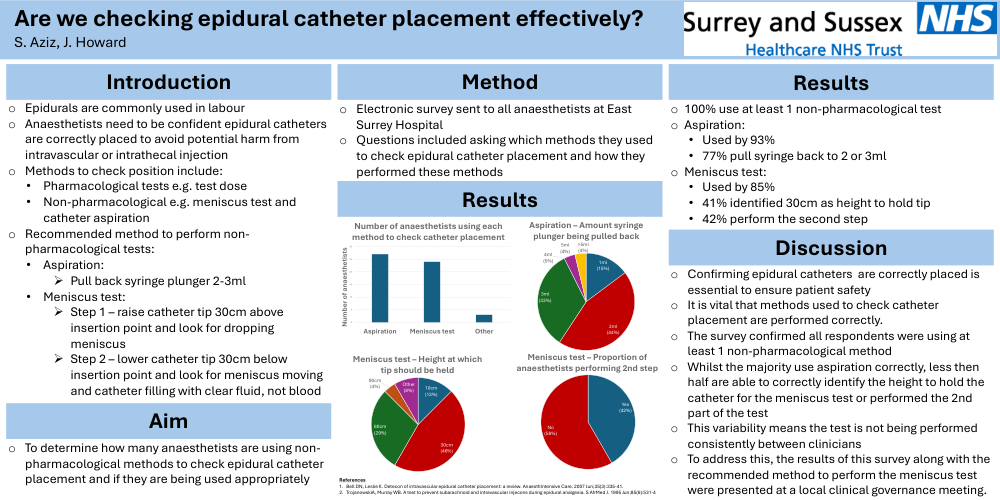
100% use at least 1 non-pharmacological test
Aspiration:
• Used by 93%
• 77% pull syringe back to 2 or 3ml
Meniscus test:
• Used by 85%
• 41% identified 30cm as height to hold tip
• 42% perform the second step
Discussion
Confirming epidural catheters are correctly placed is essential to ensure patient safety
It is vital that methods used to check catheter placement are performed correctly.
The survey confirmed all respondents were using at least 1 non-pharmacological method
Whilst the majority use aspiration correctly, less then half are able to correctly identify the height to hold the catheter for the meniscus test or performed the 2nd part of the test
This variability means the test is not being performed consistently between clinicians
To address this, the results of this survey along with the recommended method to perform the meniscus test were presented at a local clinical governance meeting.