150 posters, 16 sessions, 294 authors, 70 institutions
ePostersLive by SciGen Technologies S.A. All rights reserved.
Obstetric Anaesthesia Annual Scientific Meeting 2024
Thursday 9 - Friday 10 May 2024, Birmingham

6286644
A fungal rash and its implications for spinal anaesthesia in labour
Poster Presenter
Part of Topic
The Implications of a Fungal Rash for Labour Analgesia and Anaesthesia
Meningeal translocation of pathogens is a recognised complication of neuraxial anaesthesia.
A resultant infective fungal meningitis has a high mortality rate ranging from 100% if not treated, to 10% even if appropriate prompt management is initiated.1
We report the case of a 29-year-old gravida 1 para 0 lady presenting for post-dates induction of labour at 40+3 weeks. Her medical comorbidities recognised at term include childhood asthma, raised booking body mass index (BMI) of 46 and autism. Antenatal anaesthetic pre-assessment was completed via telephone, and on arrival to Central Delivery Suit (CDS) early epidural counselling was conducted face to face by the day anaesthetic team in in view of her raised BMI.
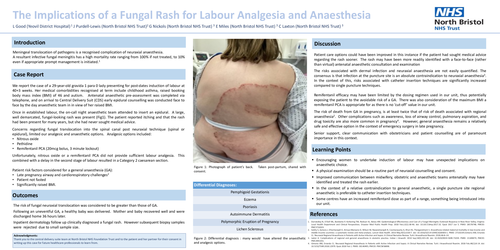
Once in established labour, the on-call night anaesthetic team attended to insert an epidural. A large, well demarcated, fungal-looking rash was present (Fig1). The patient reported itching and that the rash had been present for many years, but she had never sought medical advice.
Concerns regarding fungal translocation into the spinal canal post neuraxial technique (spinal or epidural), limited our analgesic and anaesthetic options. Analgesic options included:
Unfortunately, nitrous oxide or a remifentanil PCA did not provide sufficient labour analgesia. This combined with a delay in the second stage of labour resulted in a Category 2 caesarean section.
Patient risk factors considered for a general anaesthesia (GA):
The risk of fungal neuraxial translocation was considered to be greater than those of GA.
Following an uneventful GA, a healthy baby was delivered. Mother and baby recovered well and were discharged home 36 hours later.
Inpatient dermatology follow up clinically diagnosed a fungal rash. However subsequent biopsy samples were rejected due to small sample size.
Patient care options could have been improved in this instance if the patient had sought medical advice regarding the rash sooner. The rash may have been more readily identified with a face-to-face (rather than virtual) antenatal anaesthetic consultation and examination
The risks associated with dermal infection and neuraxial anaesthesia are not easily quantified. The consensus is that infection at the puncture site is an absolute contraindication to neuraxial anaesthesia3. In the context of this, risks associated with catheter insertion techniques are significantly increased compared to single puncture techniques.
Remifentanil efficacy may have been limited by the dosing regimen used in our unit, thus potentially exposing the patient to the avoidable risk of a GA. There was also consideration of the maximum BMI a remifentanil PCA is appropriate for as there is no ‘cut-off’ value in our unit.
The risk of death from GA in pregnancy, is at least twice that of risk of death associated with regional anaesthesia2. Other complications such as awareness, loss of airway control, pulmonary aspiration, and drug toxicity are also more common in pregnancy4. However, general anaesthesia remains a relatively safe and effective option in the context of emergency surgery in late pregnancy.
Senior support, clear communication with obstetricians and patient counselling are of paramount importance in this context.