150 posters, 16 sessions, 294 authors, 70 institutions
ePostersLive by SciGen Technologies S.A. All rights reserved.
Obstetric Anaesthesia Annual Scientific Meeting 2024
Thursday 9 - Friday 10 May 2024, Birmingham

6301427
A successful elective caesarian birth in a 23 year old primigravadia with vascular Ehlers Danlos.
Poster Presenter
Authors
Part of Topic
Introduction
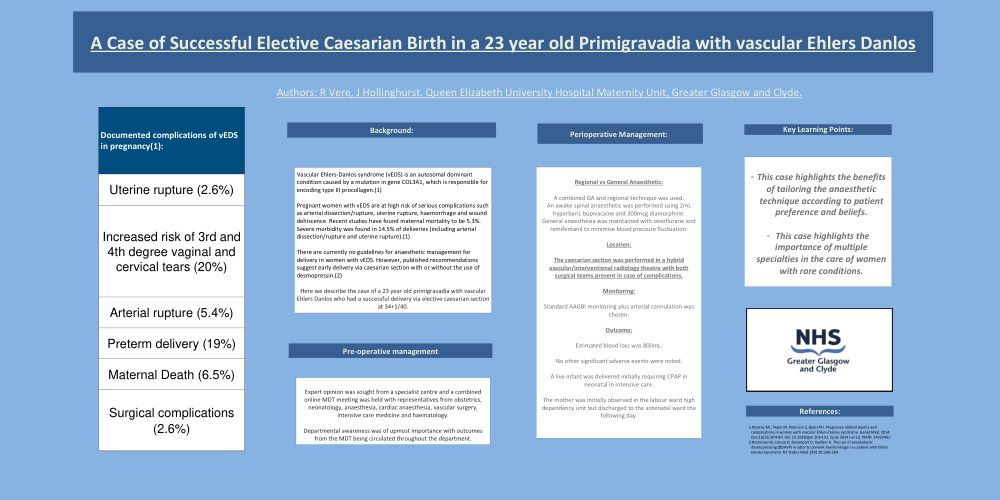
Vascular Ehlers-Danlos syndrome (vEDS), also known as Ehlers-Danlos type IV is an autosomal dominant condition caused by a mutation in gene COL3A1, which is responsible for encoding type III procollagen.
Pregnant women with vEDS are at high risk of serious complications such as arterial dissection/rupture, uterine rupture, haemorrhage and wound dehiscence. Most recent studies have found maternal mortality to be 5.3%. Severe morbidity was found in 14.5% of deliveries (including arterial dissection/rupture and uterine rupture).
There are currently no guidelines for anaesthetic management for delivery in women with vEDS. However, published recommendations suggest early delivery via caesarian section with or without the use of desmopressin.
Case Report
We describe the case of a 23-year-old primigravadia with vascular Ehlers Danlos who had a successful delivery via elective caesarian section at 34+1/40. Expert opinion was sought from a specialist centre and a combined online MDT was held with representatives from obstetrics, obstetric medicine, neonatology, anaesthesia, cardiac anaesthesia, vascular surgery, intensive care medicine and haematology.
There was limited evidence on anaesthetic technique but based on the patient’s risk of bleeding we opted to perform the operation under general anaesthesia. Neuroaxial anaesthesia is sometimes avoided due to the risk of vertebral haematoma but given the patient’s self-reported poor tolerance to pain we performed a spinal with 2ml heavy marcaine and 300mcg diamorphine prior to induction.
Central venous access was avoided because of the danger of vessel rupture however we did choose to insert an arterial line in order to control the blood pressure more closely.
General anaesthesia was maintained with sevoflurane and remifentanil, which was chosen to avoid spikes in the blood pressure.
The operation was performed in a hybrid vascular/interventional radiology theatre. The estimated blood loss was 800ml with no adverse events noted. A live infant was delivered and initially required some ventilatory support via CPAP in neonatal intensive care. The mother was initially observed in high dependency but discharged to labour ward the following day.
Discussion
The case highlights the benefits of involving multiple specialties in the care of women with rare conditions. It also highlights the benefits of tailoring anaesthetic technique based on patient preference and beliefs.