150 posters, 16 sessions, 294 authors, 70 institutions
ePostersLive by SciGen Technologies S.A. All rights reserved.
Obstetric Anaesthesia Annual Scientific Meeting 2024
Thursday 9 - Friday 10 May 2024, Birmingham

6300567
Identification of the deteriorating septic mother: a role for point of care tests.
Poster Presenter
Authors
Affiliations
Part of Topic
IDENTIFICATION OF THE DETERIORATING SEPTIC MOTHER: A ROLE FOR POINT OF CARE TESTS
G. Moncrieff, L. DeLloyd, R. Collis, S. Bell
University Hospital of Wales, Cardiff, UK
Introduction
•Sepsis represents 10% of maternal deaths [1], complicated by coagulopathy in 34% of intensive care unit (ICU) admissions [2].
•This case series describes the clinical course and spectrum of coagulopathy of three mothers admitted to ICU with severe sepsis over a 2 yearperiod. In all cases microbiological samples confirmed Escherichia coli infection and placental histology showed acute chorioamnionitis.
•Point of care tests (ROTEM and lactate) were performed due cardiovascular instability and clinical concern. Clinical utility and interpretation of results is discussed.
Case One
•21-year-old G2P1 presented at 17 wks with preterm rupture of membranes, intrauterine death and pyrexia (39.4°C). Intravenous antibiotics were commenced.
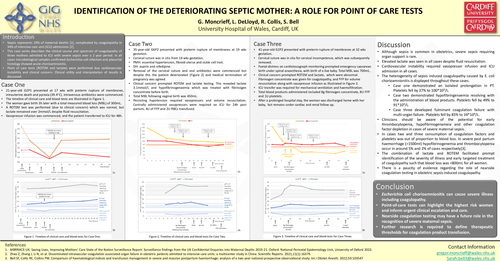
•The timeline of clinical care and blood tests are illustrated in Figure 1.
•The woman gave birth 3h later with a total measured blood loss (MBL) of 300mL.
•A ROTEM test was performed (due to clinical concern) which was normal, but lactate remained over 2mmol/L despite fluid resuscitation.
•Vasopressor infusion was commenced, and the patient transferred to ICU for 48h.
Case Two
•35-year-old G6P2 presented with preterm rupture of membranes at 19 wks gestation.
•Cervical suture was in situ from 14 wks gestation.
•PMH: essential hypertension, fibroid uterus and sickle cell trait.
•DH: aspirin and nifedipine.
•Removal of the cervical suture and oral antibiotics were commenced but despite this the patient deteriorated (Figure 2) and medical termination of pregnancy was agreed.
•Clinical concern prompted ROTEM and lactate testing. This revealed lactate 3.1mmol/L andhypofibrinogenaemia which was treated with fibrinogen concentrate before birth.
•Total MBL following vaginal birth was 450mL.
•Persisting hypotension required vasopressors and volume resuscitation. Centrally administered vasopressors were required on ICU for 24h post partum, 4U of FFP and 2U RBCs transfused.
Case Three
•41-year-old G2P2 presented with preterm rupture of membranes at 32 wks gestation.
•Cervical suture was in situ for cervical incompetence, which was subsequently removed.
•Foetal distress on cardiotocograph monitoring prompted emergency caesarean birth under spinal anaesthesia, with birth of a live baby. Total MBL was 700mL.
•Clinical concern prompted ROTEM and lactate, which were abnormal. Fibrinogen concentrate was given for coagulopathy, and FFP for volume resuscitation along with vasopressor infusion as illustrated in Figure 3.
•ICU transfer was required for mechanical ventilation and haemofiltration.
•Total blood products administered included 8g fibrinogen concentrate, 8U FFP and 1U platelets.
•After a prolonged hospital stay, the woman was discharged home with her baby, but remains under cardiac and renal follow up.
Discussion
•Although sepsis is common in obstetrics, severe sepsis requiring organ support is rare.
•Elevated lactate was seen in all cases despite fluid resuscitation.
•Cardiovascular instability required vasopressor infusion and ICU admission in all cases.
•The heterogeneity of sepsis induced coagulopathy caused by E. coli chorioamnionitis is displayed throughout these cases.
•Case one demonstrated an isolated prolongation in PT. Platelets fell by 37% to 100*109/L.
•Case two demonstrated hypofibringenaemia resolving with the administration of blood products. Platelets fell by 49% to 91*109/L.
•Case three developed fulminant coagulation failure with multi-organ failure. Platelets fell by 85% to 34*109/L.
•Clinicians should be aware of the potential for early thrombocytopenia, hypofibrinogenameia and other coagulation factor depletion in cases of severe maternal sepsis.
•In cases two and three consumption of coagulation factors and platelets was out of proportion to blood loss. In severe post partum haemorrhage (>1500ml) hypofibrinogenemia and thrombocytopenia occur in around 5% and 2% of cases respectively[3].
•The combination of lactate and ROTEM facilitated prompt identification of the severity of illness and early targeted treatment of coagulopathy such that blood loss was <800mL for all women.
•There is a paucity of evidence regarding the role of nearside coagulation testing in obstetric sepsis induced coagulopathy.
Conclusion
•Escherichia coli chorioamnionitis can cause severe illness including coagulopathy.
•Point-of-care tests can highlight the highest risk women and inform urgent clinical escalation and care.
•Nearside coagulation testing may have a future role in the recognition of severe maternal sepsis.
•Further research is required to define therapeutic thresholds for coagulation product transfusion.