150 posters, 16 sessions, 294 authors, 70 institutions
ePostersLive by SciGen Technologies S.A. All rights reserved.
Obstetric Anaesthesia Annual Scientific Meeting 2024
Thursday 9 - Friday 10 May 2024, Birmingham

6301642
A needle free induction: Managing a parturient with severe treatment-resistant needle phobia, presenting for elective caesarean section.
Poster Presenter
Authors
Affiliations
Part of Topic
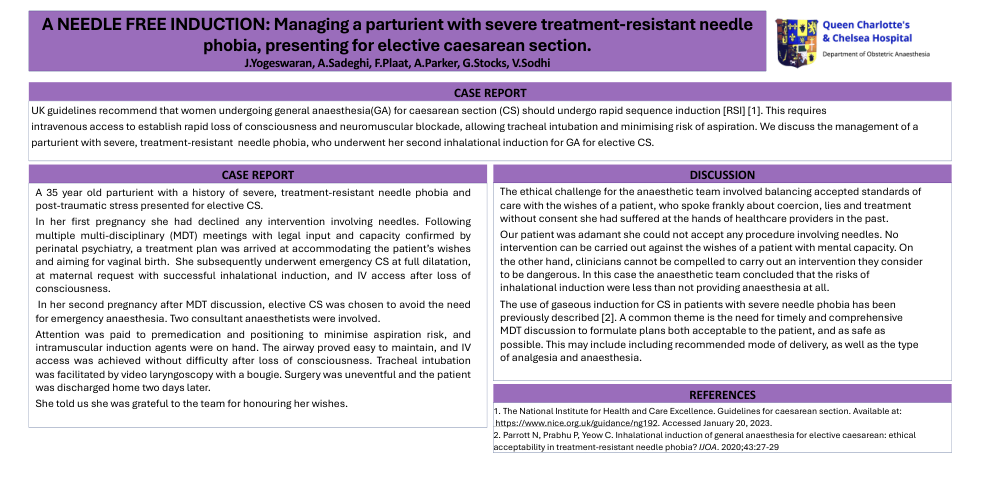
A NEEDLE FREE INDUCTION: Managing a parturient with severe treatment-resistant needle phobia, presenting for elective caesarean section.
J.Yogeswaran, A.Sadeghi, F.Plaat, A.Parker, G.Stocks, V.Sodhi
UK guidelines recommend that women undergoing general anaesthesia(GA) for caesarean section (CS) should undergo rapid sequence induction [RSI] [1]. This requires intravenous access to establish rapid loss of consciousness and neuromuscular blockade, allowing tracheal intubation and minimising risk of aspiration. We discuss the management of a parturient with severe, treatment-resistant needle phobia, who underwent her second inhalational induction for GA for elective CS.
Introduction
A 35 year old parturient with a history of severe, treatment-resistant needle phobia and post-traumatic stress presented for elective CS.
In her first pregnancy she had declined any intervention involving needles. Following multiple multi-disciplinary (MDT) meetings with legal input and capacity confirmed by perinatal psychiatry, a treatment plan was arrived at accommodating the patient’s wishes and aiming for vaginal birth. She subsequently underwent emergency CS at full dilatation, at maternal request with successful inhalational induction, and IV access after loss of consciousness.
In her second pregnancy after MDT discussion, elective CS was chosen to avoid the need for emergency anaesthesia. Two consultant anaesthetists were involved.
Attention was paid to premedication and positioning to minimise aspiration risk, and intramuscular induction agents were on hand. The airway proved easy to maintain, and IV access was achieved without difficulty after loss of consciousness. Tracheal intubation was facilitated by video laryngoscopy with a bougie. Surgery was uneventful and the patient was discharged home two days later.
She told us she was grateful to the team for honouring her wishes.
Discussion
The ethical challenge for the anaesthetic team involved balancing accepted standards of care with the wishes of a patient, who spoke frankly about coercion, lies and treatment without consent she had suffered at the hands of healthcare providers in the past.
Our patient was adamant she could not accept any procedure involving needles. No intervention can be carried out against the wishes of a patient with mental capacity. On the other hand, clinicians cannot be compelled to carry out an intervention they consider to be dangerous. In this case the anaesthetic team concluded that the risks of inhalational induction were less than not providing anaesthesia at all.
The use of gaseous induction for CS in patients with severe needle phobia has been previously described [2]. A common theme is the need for timely and comprehensive MDT discussion to formulate plans both acceptable to the patient, and as safe as possible. This may include including recommended mode of delivery, as well as the type of analgesia and anaesthesia.
References
1. The National Institute for Health and Care Excellence. Guidelines for caesarean section. Available at:
https://www.nice.org.uk/guidance/ng192. Accessed January 20, 2023.
2. Parrott N, Prabhu P, Yeow C. Inhalational induction of general anaesthesia for elective caesarean: ethical acceptability in treatment-resistant needle phobia? IJOA. 2020;43:27-29