150 posters, 16 sessions, 294 authors, 70 institutions
ePostersLive by SciGen Technologies S.A. All rights reserved.
Obstetric Anaesthesia Annual Scientific Meeting 2024
Thursday 9 - Friday 10 May 2024, Birmingham

6330340
Sustainability and Safety in Obstetric Anaesthesia
Poster Presenter
Authors
Part of Topic
Improving Sustainability and Safety in Obstetric Theatres
Introduction:
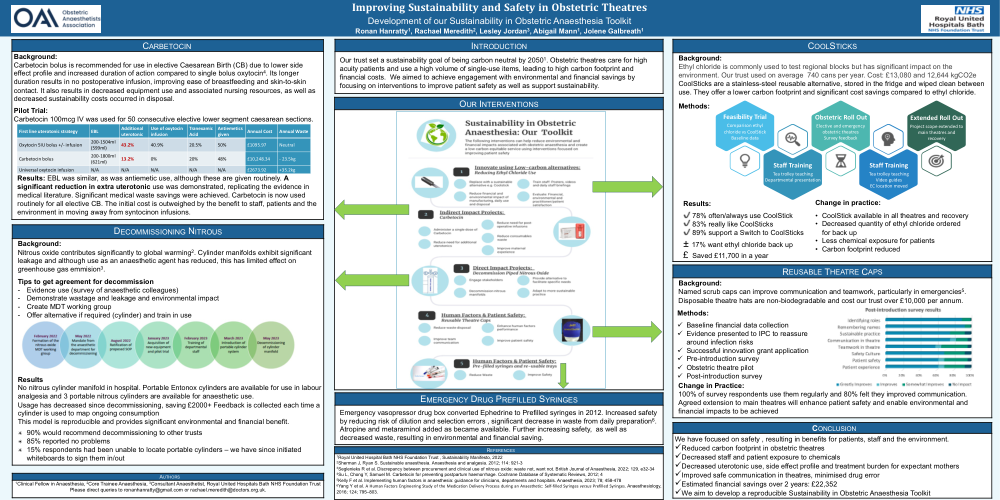
Our trust set a sustainability goal of being carbon neutral by 20501. Obstetric theatres care for high acuity patients and use a high volume of single-use items, leading to high carbon footprint and financial costs. We aimed to achieve engagement withenvironmental and financial savings by focusing on interventions to improve patient safety as well as support sustainability.
Carbetocin:
Background:
Carbetocin bolus is recommended for use in elective Caesarean Birth (CB) due to lower side effect profile and increased duration of action compared to single bolus oxytocin4. Its longerduration results in no postoperative infusion, improving ease of breastfeeding and skin-to-skin contact. It also results in decreased equipment use and associated nursing resources, as well as decreased sustainability costs occurred in disposal.
Pilot Trial:
Carbetocin 100mcg IV was used for 50 consecutive elective lower segment caesarean sections.
Results: EBL was similar, as was antiemetic use, although these are given routinely. A significant reduction in extra uterotonic use was demonstrated, replicating the evidence in medical literature. Significant medical waste savings were achieved. Carbetocin is now used routinely for all elective CB. The initial cost is outweighed by the benefit to staff, patients and the environment in moving away from syntocinon infusions.
Decommissioning Piped Bitrous Oxide
Background:
Nitrous oxide contributes significantly to global warming2. Cylinder manifolds exhibitsignificant leakage and although use as an anaesthetic agent has reduced, this has limited effect on greenhouse gas emmision3.
Tips to get agreement for decommission
Results
No nitrous cylinder manifold in hospital. Portable Entonox cylinders are available for use in labour analgesia and 3 portable nitrous cylinders are available for anaesthetic use.
Usage has decreased since decommissioning,saving £2000+ Feedback is collected each time a cylinder is used to map ongoing consumption
This model is reproducible and provides significant environmental and financial benefit.
Emergency vasopressor drug box converted Ephedrine to Prefilled syringes in 2012. Increased safety by reducing risk of dilution and selection errors , significant decrease in waste from daily preparation6. Atropine and metaraminol added as became available. Further increasing safety, as well as decreased waste, resulting in environmental and financial saving.
CoolSticks:
Ethyl chloride is commonly used to test regional blocks but has significant impact on the environment. Our trust used on average 740 cans per year. Cost: £13,080 and 12,644 kgCO2e
CoolSticks are a stainless-steel reusable alternative, stored in the fridge and wiped clean between use. They offer a lower carbon footprint and significant cost savings compared to ethyl chloride.
Results:
✔️ 78% often/always use CoolStick
✔️ 83% really like CoolSticks
✔️ 89% support a Switch to CoolSticks
± 17% want ethyl chloride back up
£ Saved £11,700 in a year
Change in practice:
Named scrub caps can improve communication and teamwork, particularly in emergencies5. Disposable theatre hats are non-biodegradable and cost our trust over £10,000 per annum.
Methods:
Change in Practice:
100% of survey respondents use them regularly and 80% felt they improved communication. Agreed extension to main theatres will enhance patient safety and enable environmental and financial impacts to be achieved
Conclusion
We have focused on safety , resulting in benefits for patients, staff and the environment.