150 posters, 16 sessions, 294 authors, 70 institutions
ePostersLive by SciGen Technologies S.A. All rights reserved.
Obstetric Anaesthesia Annual Scientific Meeting 2024
Thursday 9 - Friday 10 May 2024, Birmingham

6293521
An analysis of pain during caesarean section in a tertiary maternity hospital
Poster Presenter
Authors
Affiliations
null,
Part of Topic
Title: An audit of intra-operative pain during Caesarean section in a tertiary maternity hospital
Introduction
Intra-operative pain during caesarean section (PDS)/ (CS) is the leading cause of anaesthesia-related maternal distress and successful litigation against obstetric anaesthesiologists (Plaat et al., 2022). PDS can result in post-traumatic stress disorder (PTSD) of the mother (Anaesthesiologists, 2023) and may also require conversion to general anaesthesia (GA). Unplanned GA may impact on the immediate birth experience and result in maternal dissatisfaction. Current standards set by the Royal College of Anaesthetists (RCoA) suggest that rates of PDS should be <5% for category 4, <15% for categories 2-3, and <20 % for category 1 sections and that conversion rates to GA due to neuraxial complications should be <1% for category 4, <5% for categories 2-3 and <15% for category 1 patients. Failure of neuraxial anaesthesia for CS is thought to occur in up to 6% of spinal anaesthetics, and up to 24% of epidural top-ups for CS (Plaat et al., 2022). The recommended sensory level blockade from neuraxial anaesthesia as per the AAGBI guideline (2022) is up to and including T5. Optimal motor blockade recommendation remains unclear, at a minimum the mother should be unable to straight leg raise as per the same guideline. Pain occurring during the section but prior to delivery of the baby should prompt an offer of general anaesthesia to the patient.
Aims:
- To evaluate the annual incidence of PDS and the conversion rates to GA during caesarean sections (CS) in a tertiary maternity hospital.
- To evaluate the proportion of PDS attributable to failed epidural or spinal anaesthesia.
- To identify at which stage of the surgery pain occurred
- To define the level of sensory and motor block in cases of PDS.
- To gather basic patient characteristics that may guide future quality improvement studies
Methods:
From July 2022-June 2023, data were collected from the clinical incident management system and the electronic patient records. This included baseline demographic data, the incidence of PDS and rates of conversion to GA. In addition, we analysed the level of sensory and motor block in cases of PDS and the proportion of PDS cases attributable to failed epidural or failed spinal anaesthesia.
Results:
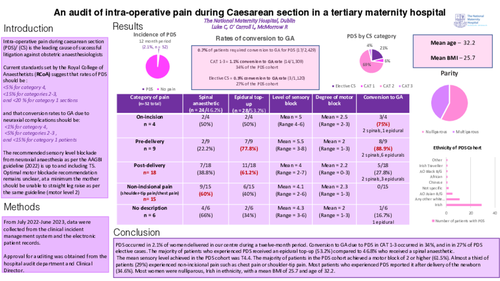
We identified data on 2,429 patients undergoing CS during the 12-month study period, of whom 52 (2.1%) experienced PDS. For category 1-3 patients, 3.1% (41/1,309) experienced PDS, while 1% (11/1,120) of elective CS patients experienced PDS. (Electives = 11/52 (21.2%), CAT 1 = 3/52 (5.8%), CAT2 = 36/52 (69.2%), CAT 3 = 2/52 (3.8%))
Of the total number of CS (2429), 17 patients (0.7%) required conversion to GA because of PDS. For category 1-3 patients, the rate of conversion to GA during CS was 1.1% of the total patients (14/1,309 patients) and 34% of the PDS cohort. For category 4/elective CS patients, the rate of conversion to GA during CS was 0.3% of total patients (3/1,120 patients) and 27% of the PDS cohort.
Conclusion:
Pain during section (PDS) occurred in 2.1% of women delivered in our centre during a twelve month period. Our figures are in keeping with RCoA guidelines as described. PDS occurred more commonly in CAT 1-3 CS than elective CS (3.1% and 1% respectively). Conversion to GA due to PDS in CAT 1-3 occurred in 34%, and in in 27% of PDS elective cases. The majority of patients who experienced PDS received an epidural top-up (53.2%) compared to 46.8% who received a spinal anaesthetic. The mean sensory level achieved in the PDS cohort was T4.4, with a median of T4. The majority of patients in the PDS cohort achieved a motor block of 2 or higher (61.5%). Almost a third of patients (29%) experienced non-incisional pain such as chest pain or shoulder-tip pain. Most patients who experienced PDS reported it after delivery of the newborn (34.6%). Most women were nulliparous, Irish in ethnicity, with a mean BMI of 25.7 and age of 32.2. PDS is a serious complication of neuraxial anaesthesia which can occur despite adequate assessment criteria being met. Non-incisional pain, such as shoulder-tip pain can also be distressing, and clearer guidance is needed on how best to manage this condition intra-operatively.