150 posters, 16 sessions, 294 authors, 70 institutions
ePostersLive by SciGen Technologies S.A. All rights reserved.
Obstetric Anaesthesia Annual Scientific Meeting 2024
Thursday 9 - Friday 10 May 2024, Birmingham

6278321
Acute severe pain after caesarean delivery impedes maternal recovery: time for a new approach?
Poster Presenter
Part of Topic
Introduction
•Pain following caesarean delivery (CD) can be severe in over half of patients1.
•Poorly managed pain may have both short and long-term detriments to maternal recovery, including impacts on mental health and even infant development2.
•Opioids are considered integral to postoperative pain management as part of multimodal analgesia regime.3
•The aim was to analyse post operative opioid consumption in Morphine Milligram Equivalents (MME) and quality of maternal recovery, pain scores and time patients felt ready for discharge (TRD).
Methods
•Study design: Prospective study.
•n=100.
•April-October 2023.
•Data acquired via electronic health record and concurrent patient survey.
•Electronic health record: demographics, opioid consumption, LOS.
•Patient survey: patient satisfaction and Obstetric Quality of Recovery (Obs-QoR 10) scores (including patient-reported pain scores) and TRD.
Results
•98 CDs were performed under neuraxial techniques.
•Haematological contraindications in the two patients who required GA.
•Postoperative regimen in 93% of patients included regular paracetamol and non-steroidal anti-inflammatory drugs (NSAIDs) with opioids prn.
•NSAIDs were contraindicated in 6 patients.
•Morphine PCA was prescribed in the two patients who had a GA.
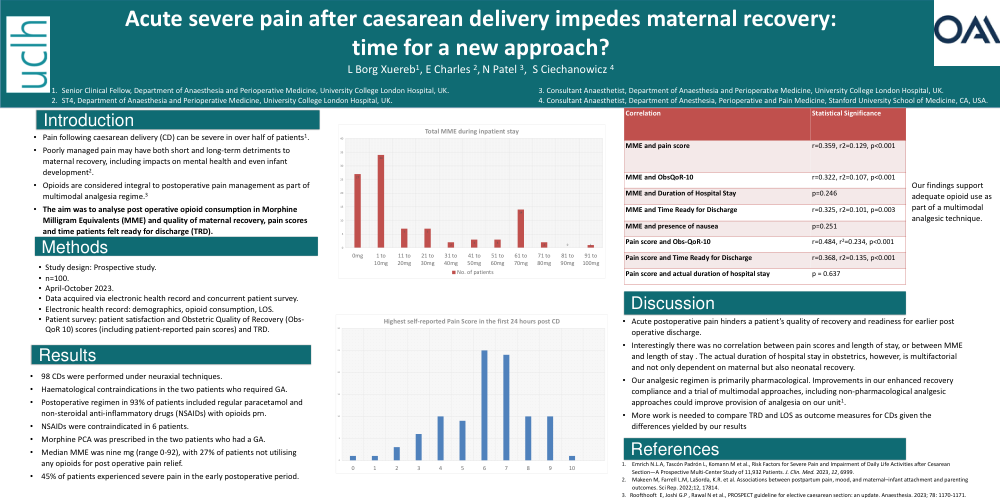
•Median MME was nine mg (range 0-92), with 27% of patients not utilising any opioids for post operative pain relief.
•45% of patients experienced severe pain in the early postoperative period
Discussion
•Acute postoperative pain hinders a patient’s quality of recovery and readiness for earlier post operative discharge.
•Interestingly there was no correlation between pain scores and length of stay, or between MME and length of stay . The actual duration of hospital stay in obstetrics, however, is multifactorial and not only dependent on maternal but also neonatal recovery.
•Our analgesic regimen is primarily pharmacological. Improvements in our enhanced recovery compliance and a trial of multimodal approaches, including non-pharmacological analgesic approaches could improve provision of analgesia on our unit1.
•More work is needed to compare TRD and LOS as outcome measures for CDs given the differences yielded by our results