150 posters, 16 sessions, 294 authors, 70 institutions
ePostersLive by SciGen Technologies S.A. All rights reserved.
Obstetric Anaesthesia Annual Scientific Meeting 2024
Thursday 9 - Friday 10 May 2024, Birmingham

6301975
Implementation of Programmed Intermittent Epidural Boluses (PIEB) for Labour analgesia in a District General Hospital (DGH)
Poster Presenter
Authors
Affiliations
Part of Topic
Implementation of Programmed Intermittent Epidural Boluses (PIEB) for Labour analgesia in a District General Hospital
Harha A, Barclay P, Patel R and Prior C. West Middlesex University Hospital, London, UK
Introduction
•PIEB + patient controlled epidural analgesia (PCEA) is commonly used for labour analgesia in North America, where benefit over continuous epidural infusion (CEI) + PCEA has been demonstrated1
•This evidence is less applicable in the UK, where CEI for labour is rarely used
•Evidence that PIEB + PCEA reduces breakthrough pain and motor block when compared with PCEA alone is emerging2
•We designed a QIP to change from PCEA alone (a delivery method used widely in the UK) to PIEB + PCEA and analysed key outcomes
Methods
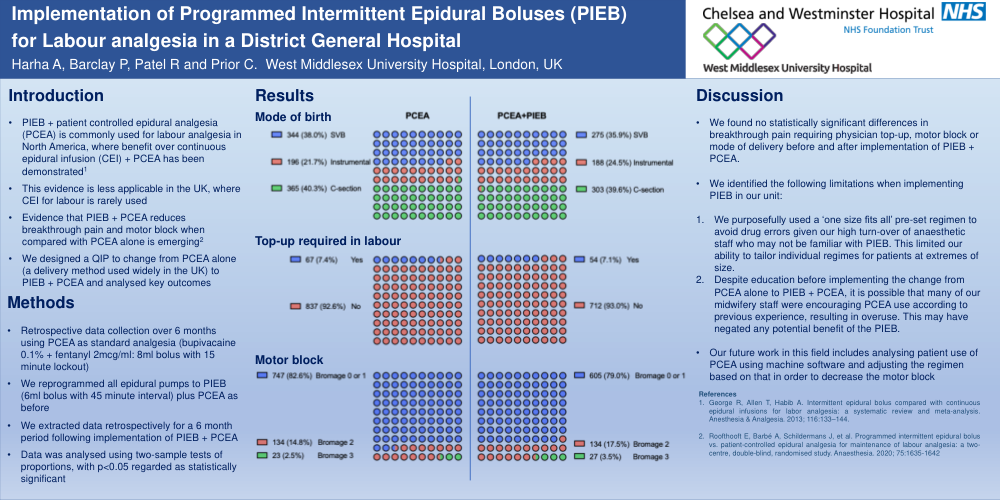
•Retrospective data collection over 6 months using PCEA as standard analgesia (bupivacaine 0.1% + fentanyl 2mcg/ml: 8ml bolus with 15 minute lockout)
•We reprogrammed all epidural pumps to PIEB (6ml bolus with 45 minute interval) plus PCEA as before
•We extracted data retrospectively for a 6 month period following implementation of PIEB + PCEA
•Data was analysed using two-sample tests of proportions, with p<0.05 regarded as statistically significant
Discussion
•We found no statistically significant differences in breakthrough pain requiring physician top-up, motor block or mode of delivery before and after implementation of PIEB + PCEA.
•We identified the following limitations when implementing PIEB in our unit:
1.We purposefully used a ‘one size fits all’ pre-set regimen to avoid drug errors given our high turn-over of anaesthetic staff who may not be familiar with PIEB. This limited our ability to tailor individual regimes for patients at extremes of size.
2.Despite education before implementing the change from PCEA alone to PIEB + PCEA, it is possible that many of our midwifery staff were encouraging PCEA use according to previous experience, resulting in overuse. This may have negated any potential benefit of the PIEB.
•Our future work in this field includes analysing patient use of PCEA using machine software and adjusting the regimen based on that in order to decrease the motor block