150 posters, 16 sessions, 294 authors, 70 institutions
ePostersLive by SciGen Technologies S.A. All rights reserved.
Obstetric Anaesthesia Annual Scientific Meeting 2024
Thursday 9 - Friday 10 May 2024, Birmingham

6301830
Influence of BMI and ethnicity on the depth of the epidural space in parturients
Poster Presenter
Authors
Affiliations
Part of Topic
Introduction
Correct identification of the epidural space is a vital skill for anaesthetists, often acquired in the first two years of training. Successful placement of an epidural catheter requires thorough patient examination and familiarity with the tactile properties of the tissues of the back. Often, an increased incidence of complications such as inadvertent dural tap arise for trainees placing epidurals whilst acquiring this skill, presenting a challenge for both trainee and trainer. Experienced anaesthetists can estimate the epidural depth based on patient factors such as body habitus and ethnicity, influencing procedural caution if a loss of resistance is encountered at a depth grossly different to this. In this project we examine how the depth of the space varies with BMI and ethnicity, to demonstrate the accuracy of using patient characteristics to estimate depth prior to the procedure.
Methods
The trust IT department assisted in extracting CMIS digital records of epidurals and combined spinal and epidurals at West Middlesex Hospital since November 2007. After removing duplicate and incomplete records, 13,884 complete records were analyzed using ANOVA and Multiple Linear Regression tests in GraphPad Prism version 10.2.2 for MacOS.
Results
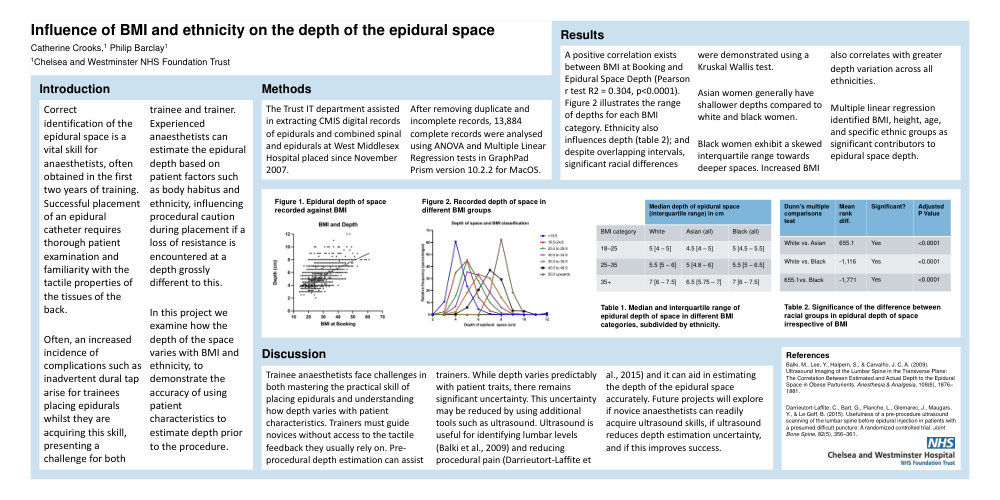
A positive correlation exists between BMI at Booking and Epidural Space Depth (Pearson r test R2 = 0.304, p<0.0001). Figure 2 illustrates the range of depths for each BMI category. Ethnicity also influences depth (table 2); and despite overlapping intervals, significant racial differences were demonstrated using a Kruskal Wallis test. Asian women generally have shallower depths compared to white and black women. Black women exhibit a skewed interquartile range towards deeper spaces. Increased BMI also correlates with greater depth variation across all ethnicities. Multiple linear regression identified BMI, height, age, and specific ethnic groups as significant contributors to epidural space depth.
Discussion
Trainee anaesthetists face challenges in both mastering the practical skill of placing epidurals and understanding how depth varies with patient characteristics. Trainers must guide novices without access to the tactile feedback they usually rely on. Pre-procedural depth estimation using patient characteristics can assist trainers. While depth varies predictably with patient traits, there remains significant uncertainty. Additional tools like ultrasound may reduce this uncertainty. Ultrasound is known for identifying lumbar levels and reducing procedural pain, and it can aid in estimating epidural space accurately. Future projects will explore if novice anaesthetists can readily acquire ultrasound skills, if ultrasound reduces depth estimation uncertainty, and if this improves success.