150 posters, 16 sessions, 294 authors, 70 institutions
ePostersLive by SciGen Technologies S.A. All rights reserved.
Obstetric Anaesthesia Annual Scientific Meeting 2024
Thursday 9 - Friday 10 May 2024, Birmingham

6301612
An Audit of Regional Analgesia in Labour -- Can Standards Be Met for Obese Patients?
Poster Presenter
Authors
Part of Topic
Introduction
The benefits of neuraxial labour analgesia for parturients with a high body mass index (BMI) are well established, as is the increased technical difficulty of placement and the risk failure1. Best practice standards for the provision of labour analgesia have been defined by the Royal College of Anaesthetists in the Quality Improvement Compendium2. The aim of this audit was to establish whether these best practice standards could be adhered to when managing patients with a high BMI in a district general hospital.
Methods
Patients were identified retrospectively over a five-month period from February-June 2023 via an obstetric anaesthetic logbook maintained by the anaesthetic department. All patients who underwent neuraxial labour analgesia with a booking BMI of greater than 30 kg/m2 were included in the audit. Subsequent data collection was conducted via the electronic patient records and the audit was registered as per local policy
Results
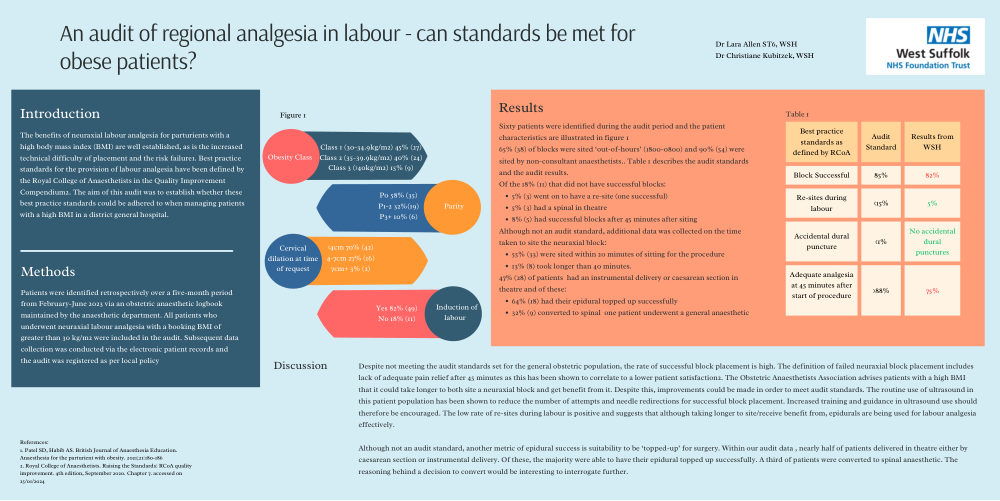
Sixty patients were identified during the audit period and the patient characteristics are illustrated in figure 1
65% (38) of blocks were sited ‘out-of-hours’ (1800-0800) and 90% (54) were sited by non-consultant anaesthetists.. Table 1 describes the audit standards and the audit results.
Of the 18% (11) that did not have successful blocks:
Although not an audit standard, additional data was collected on the time taken to site the neuraxial block:
47% (28) of patients had an instrumental delivery or caesarean section in theatre and of these:
Discussion
Despite not meeting the audit standards set for the general obstetric population, the rate of successful block placement is high. The definition of failed neuraxial block placement includes lack of adequate pain relief after 45 minutes as this has been shown to correlate to a lower patient satisfaction2. The Obstetric Anaesthetists Association advises patients with a high BMI that it could take longer to both site a neuraxial block and get benefit from it. Despite this, improvements could be made in order to meet audit standards. The routine use of ultrasound in this patient population has been shown to reduce the number of attempts and needle redirections for successful block placement1. Increased training and guidance in ultrasound use should therefore be encouraged. The low rate of re-sites during labour is positive and suggests that although taking longer to site/receive benefit from epidurals are being used for labour analgesia effectively.
Although not an audit standard, another metric of epidural success is suitability to be ‘topped-up’ for surgery. Within our audit data , nearly half of patients delivered in theatre either by caesarean section or instrumental delivery. Of these, the majority were able to have their epidural topped up successfully. A third of patients were converted to spinal anaesthetic. The reasoning behind a decision to convert would be interesting to interrogate further.