150 posters, 16 sessions, 294 authors, 70 institutions
ePostersLive by SciGen Technologies S.A. All rights reserved.
Obstetric Anaesthesia Annual Scientific Meeting 2024
Thursday 9 - Friday 10 May 2024, Birmingham

6299488
Navigating Diagnostic Dilemmas: Distinguishing Acute Fatty Liver of Pregnancy from HELLP syndrome - A Case Report
Poster Presenter
Authors
Affiliations
Part of Topic
Case Report:
A 36-year-old woman (G1P0) presented to the maternity assessment unit at 35 week’s gestation with a 7 day history of vomiting, intermittent abdominal pain and reduced oral intake. She was hypertensive (154/82mmHg) and tachycardic (105 bpm), with mild proteinuria and elevated serum lactate. Cardiotocography was non-reassuring and given the unclear pathology the patient was consented for category 1 emergency caesarean birth under general anaesthesia.
Surgery was uneventful, there was a notable delay in response to sugammadex. Following extubation the patient was admitted to the obstetric high dependency unit.
Blood testing showed liver and renal dysfunction with coagulopathy. In the hours following surgery the patient developed hypogylcaemia and scleral jaundice. There were two episodes of seizure activity which were treated with IV magnesium sulphate. The patient became unconscious and developed extreme hyporeflexia thought to be due to iatrogenic hypermagnesaemia. She developed airway compromise and cardiovascular collapse. The patient was re-intubated, commenced on vasopressors and admitted to intensive care where she remained for 48 hours.
CT imaging showed no acute intracranial or intrabdominal pathology.
The patient remained in hospital for 10 days and at time of discharge her renal function and liver impairment had largely resolved.
Discussion:
Acute fatty liver of pregnancy (AFLP) is a rare condition thought to belong to a spectrum of conditions such as HELLP (haemolysis, elevated liver enzymes, low platelets) syndrome, intrahepatic cholestasis (ICP) and pre-eclampsia. It affects 5 per 100,000pregnancies and presents suddenly during the third trimester. It is associated with poor maternal and foetal outcomes
Initial diagnoses for this patient included pre-eclampsia and HELLP syndrome. However, the development of hypoglycaemia and lack of platelet abnormality along with renal impairment made the diagnosis of AFLP more likely.
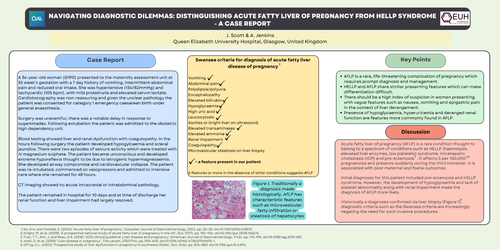
Historically a diagnoses confirmed via liver biopsy (Figure 1), diagnostic criteria such as the Swansea criteria are increasingly negating the need for such invasive procedures.
Key points:
- AFLP is a rare, life-threatening complication of pregnancy which requires prompt diagnosis and management.
- HELLP and AFLP share similar presenting features which can make differentiation difficult.
- There should be a high index of suspicion in women presenting with vague features such as nausea, vomiting and epigastric pain in the context of liver derangement.
- Presence of hypoglycaemia, hyperuricemia and deranged renal function are features more commonly found in AFLP.
Swansea criteria for diagnosis of acute fatty liver disease of pregnancy
Vomiting
Abdominal pain
Polydipsia/polyuria
Encephalopathy
Elevated bilirubin
Hypoglycaemia
High uric acid
Leucocytosis
Ascites or bright liver on ultrasound.
Elevated transaminases
Elevated ammonia
Renal impairment
Coagulopathy
Microvesicular steatosis on liver biopsy
6 features or more in the absence of other conditions suggests AFLP