150 posters, 16 sessions, 294 authors, 70 institutions
ePostersLive by SciGen Technologies S.A. All rights reserved.
Obstetric Anaesthesia Annual Scientific Meeting 2024
Thursday 9 - Friday 10 May 2024, Birmingham

6278458
Remifentanil PCA in labour - a review of local practice
Poster Presenter
Authors
Affiliations
Part of Topic
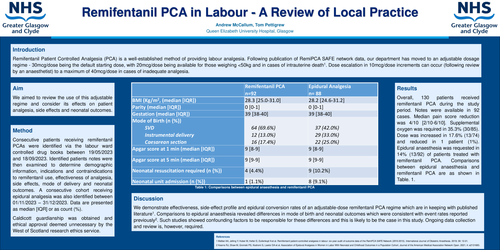
Remifentanil PCA in Labour - A Review of Local Practice
Introduction
Remifentanil Patient Controlled Analgesia (PCA) is a well-established method of providing labour analgesia. Following publication of RemiPCA SAFE network data, our department has moved to an adjustable dosage regime - 30mcg/dose being the default starting dose, with 20mcg/dose being available for those weighing <50kg and in cases of intrauterine death1. Dose escalation in 10mcg/dose increments can occur (following review by an anaesthetist) to a maximum of 40mcg/dose in cases of inadequate analgesia.
Method
Consecutive patients receiving remifentanil PCAs were identified via the labour ward controlled drug books between 19/05/2023 and 18/09/2023. Identified patients notes were then examined to determine demographic information, indications and contraindications to remifentanil use, effectiveness of analgesia, side effects, mode of delivery and neonatal outcomes. A consecutive cohort receiving epidural analgesia was also identified between 01/11/2023 – 31/12/2023. Data are presented as median [IQR] or as count (%). Caldicott guardianship was obtained and ethical approval deemed unnecessary by the West of Scotland research ethics service.
Results
Overall, 130 patients received remifentanil PCA during the study period. Notes were available in 92 cases. Median pain score reduction was 4/10 [2/10-6/10]. Supplemental oxygen was required in 35.3% (30/85). Dose was increased in 17.6% (13/74) and reduced in 1 patient (1%). Epidural anaesthesia was requested in 14% (13/92) of patients treated with remifentanil PCA. Comparisons between epidural anaesthesia and remifentanil PCA are as shown in Table. 1.
Discussion
We demonstrate effectiveness, side-effect profile and epidural conversion rates of an adjustable-dose remifentanil PCA regime which are in keeping with published literature1. Comparisons to epidural anaesthesia revealed differences in mode of birth and neonatal outcomes which were consistent with event rates reported previously2. Such studies showed confounding factors to be responsible for these differences and this is likely to be the case in this study. Ongoing data collection and review is, however, required.
References
1 Melber AA, Jelting Y, Huber M, Keller D, Dullenkopf A et al. Remifentanil patient-controlled analgesia in labour: six-year audit of outcome data of the RemiPCA SAFE Network (2010-2015). International Journal of Obstetric Anesthesia. 2019; 39: 12-21.
2 Kearns RJ, Shaw M, Gromski PS, Iliodromi S, Lawlor DA et al. Association of Epidural Analgesia in Women in Labor With Neonatal and Childhood Outcomes in a Population Cohort. Journal of the American Medical Association Network Open. 2021; 4: e2131683.