150 posters, 16 sessions, 294 authors, 70 institutions
ePostersLive by SciGen Technologies S.A. All rights reserved.
Obstetric Anaesthesia Annual Scientific Meeting 2024
Thursday 9 - Friday 10 May 2024, Birmingham

6301970
Rapid Sequence Induction in Obstetrics: a Survey of Practice across the North East and Cumbria
Poster Presenter
Authors
Part of Topic
Introduction
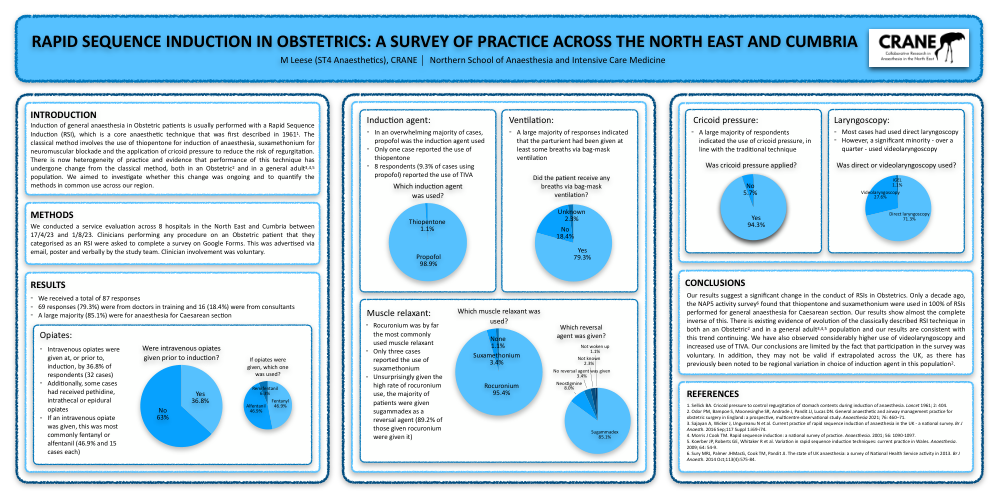
Induction of general anaesthesia in Obstetric patients is usually performed with a Rapid Sequence Induction (RSI), which is a core anaesthetic technique that was first described in 1961. The classical method involves the use of thiopentone for induction of anaesthesia, suxamethonium for neuromuscular blockade and the application of cricoid pressure to reduce the risk of regurgitation. There is now heterogeneity of practice and evidence that performance of this technique has undergone change from the classical method, both in an Obstetric and in a general adult population. We aimed to investigate whether this change was ongoing and to quantify the methods in common use across our region.
Methods
We conducted a service evaluation across 8 hospitals in the North East and Cumbria between 17/4/23 and 1/8/23. Clinicians performing any procedure on an Obstetric patient that they categorised as an RSI were asked to complete a survey on Google Forms. This was advertised via email, poster and verbally by the study team. Clinician involvement was voluntary. The project was approved as a service evaluation at each hospital and was assessed as not requiring formal ethics approval. No patient-identifiable data was collected.
Results
We received a total of 87 responses. Of these, 79.3% were from trainees and 18.4% were from consultants. A large majority (85.1%) were for anaesthesia for Caesarean section. In 36.8% of cases, an intravenous opiate was given prior to induction of anaesthesia. This was most commonly fentanyl or alfentanil (46.9% each). Propofol was used for induction of anaesthesia in 98.9% of cases. Of the cases using propofol, 9.3% used a Total Intravenous Anaesthesia (TIVA) technique. Rocuronium was the muscle relaxant of choice and was used in 95.4% of cases. Breaths via bag-mask ventilation were given in 79.3% of cases. Direct laryngoscopy was used in the majority of cases, but videolaryngoscopy was used in 27.6% of cases. Sugammadex was given in 85.1% of cases.
Conclusions
Our results suggest a significant change in the conduct of RSIs in Obstetrics. Only a decade ago, the NAP5 activity survey found that thiopentone and suxamethonium were used in 100% of RSIs performed for general anaesthesia for Caesarean section. Our results show almost the complete inverse of this. There is existing evidence of evolution of the classically described RSI technique in both an an Obstetric and in a general adult population and our results are consistent with this trend continuing. We have also observed considerably higher use of videolaryngoscopy and increased use of TIVA. Our conclusions are limited by the fact that participation in the survey was voluntary. In addition, they may not be valid if extrapolated across the UK, as there has previously been noted to be regional variation in choice of induction agent in this population.