150 posters, 16 sessions, 294 authors, 70 institutions
ePostersLive by SciGen Technologies S.A. All rights reserved.
Obstetric Anaesthesia Annual Scientific Meeting 2024
Thursday 9 - Friday 10 May 2024, Birmingham

6301837
Reducing iron deficiency anaemia in pregnancy through early identification and treatment: the introduction of a risk proforma at booking.
Poster Presenter
Authors
Alison Hare, Thomas Eraifej, Luke Yarlett, Julie Crane, Ellie Morgan
Affiliations
Part of Topic
Early identification and treatment for women at high risk of iron deficiency during pregnancy.
Introduction
Iron deficiency is the leading cause of anaemia during pregnancy, with risks to mother and foetus1. The British Society for Haematology (BSH) guidelines for iron deficiency anaemia in pregnancy describe criteria of women at high risk of iron deficiency and suggest empirical oral iron supplementation2.
Aims
To reduce the incidence of term anaemia in our obstetric population in Aneurin Bevan University Health Board by:
1) Earlier identification: the introduction of an iron deficiency risk proforma at booking appointment.
2) Earlier treatment: empirical ferrous fumarate prescribed for those identified as high risk for iron deficiency.
Method
Ethical approval was granted by the local research and development team. Patient demographics, iron prescription, 28 week and term haemoglobin (Hb) were collected for women booked at one antenatal clinic (YYF) in our health board. Baseline data was collected for October 2022. In January 2023 a booking proforma was introduced to identify those at risk of low iron as per BSH guidelines. Anaemia was defined as Hb <105 g/L. Those who transferred care to another health board or did not carry to term were excluded. Proforma use and presence of IDA risk factors were collected for those with term anaemia.
Results
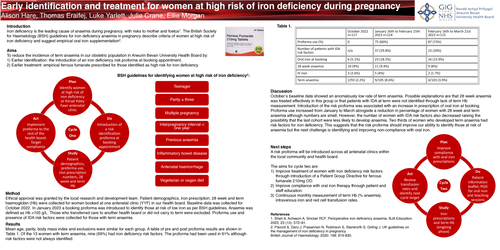
Mean age, parity, body mass index and exclusions were similar for each group. A table of pre and post proforma results are shown in Table 1. Of the 13 women with term anaemia, nine (69%) had iron deficiency risk factors. The proforma had been used in 61% although risk factors were not always identified.
Discussion
October’s baseline data showed an anomalously low rate of term anaemia. Possible explanations are that 28 week anaemia was treated effectively in this group or that patients with IDA at term were not identified through lack of term Hb measurement. Introduction of the risk proforma was associated with an increase in prescription of oral iron at booking. Proforma use increased from January to March alongside a reduction in percentage of women with 28 week and term anaemia although numbers are small. However, the number of women with IDA risk factors also decreased raising the possibility that the last cohort were less likely to develop anaemia. Two thirds of women who developed term anaemia had risk factors for iron deficiency. This suggests that the risk proforma should improve our ability to identify those at risk of anaemia but the next challenge is identifying and improving non-compliance with oral iron.
Next steps
A risk proforma will be introduced across all antenatal clinics within the local community and health board.
The aims for cycle two are:
References
1. Shah A, Acheson A, Sinclair RCF. Perioperative iron deficiency anaemia. BJA Education. 2023; 23 (10): 372–81.
2. Pavord S, Daru J, Prasannan N, Robinson S, Stanworth S, Girling J. UK guidelines on the management of iron deficiency in pregnancy.
British Journal of Haematology. 2020; 188: 819-830.