150 posters, 16 sessions, 294 authors, 70 institutions
ePostersLive by SciGen Technologies S.A. All rights reserved.
Obstetric Anaesthesia Annual Scientific Meeting 2024
Thursday 9 - Friday 10 May 2024, Birmingham

6299404
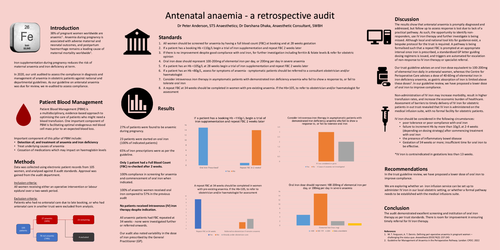
Antenatal anaemia - a retrospective audit
Poster Presenter
Authors
Affiliations
Part of Topic
Antenatal anaemia - a retrospective audit
Dr Peter Anderson, ST5 Anaesthetics; Dr Darshana Dhaka, Anaesthetic Consultant, SWBH
Introduction
38% of pregnant women worldwide are anaemic1 . Anaemia during pregnancy is associated with adverse maternal and neonatal outcomes, and postpartum haemorrhage remains a leading cause of maternal mortality worldwide1.
Iron supplementation during pregnancy reduces the risk of maternal anaemia and iron deficiency at term.
In 2020, our unit audited to assess the compliance in diagnosis and management of anaemia in obstetric patients against national and departmental guidelines. As our guideline on antenatal anaemia was due for review, we re-audited to assess compliance.
Patient Blood Management
Patient Blood Management (PBM) is a multidisciplinary, evidence-based approach to optimising the care of patients who might need a blood transfusion. One important component of PBM is facilitating optimal endogenous red blood cell mass prior to an expected blood loss.
Important component of this pillar of PBM include:
Methods
Data was collected using electronic patient records from 105 women, and analysed against 8 audit standards. Approval was gained from the audit department.
Inclusion criteria:
All women receiving either an operative intervention or labour epidural over a two-week period.
Exclusion criteria:
Patients who had no antenatal care due to late booking, or who had antenatal care in another trust were excluded from analysis.
Standards
Results
27% of patients were found to be anaemic during pregnancy.
23 patients were started on oral iron (100% of indicated patients)
65% of iron prescriptions were as per the guideline.
Only 1 patient had a Full Blood Count (FBC) re-checked after 2 weeks.
100% compliance in screening for anaemia and commencement of oral iron when indicated.
100% of anaemic women received oral iron compared to 57% in the previous audit
No patients received intravenous (IV) iron therapy despite indication.
All anaemic patients had FBC repeated at 34 weeks - none were investigated further or referred onwards.
Our audit also noted variability in the dose of iron prescribed by the General Practitioner (GP).
Discussion
The results show that antenatal anaemia is promptly diagnosed and addressed, but follow up to assess response is lost due to lack of a practical pathway. As such, the opportunity to identify non-responders, use IV iron therapy and further investigate is being missed. Although local and national tool kits for guidance exist, a bespoke protocol for the trust is required. A pathway is being formalised such that a repeat FBC is prompted at an appropriate interval once iron is prescribed, a standardised GP letter guiding dosing regimens is issued, and triggers are automated for escalation of non-response to IV iron therapy or specialist referral.
Our trust guideline advises an oral iron dose equivalent to 100-200mg of elemental iron daily in antenatal women, whereas the Centre for Perioperative Care advises a dose of 40-60mg of elemental iron in iron deficiency anaemia, as gastric absorption of iron is limited above these doses2. In our guideline review, we have proposed a lower dose of oral iron to improve compliance.
Non-administration of IV iron may increase morbidity, result in higher transfusion rates, and increase the economic burden of healthcare. Assessment of barriers to timely delivery of IV iron for obstetric patients in out trust revealed that IV iron is administered on the medical infusion suite, with no formal facility for obstetric patients.
IV iron should be considered in the following circumstances:
*IV iron is contraindicated in gestations less than 13 weeks.
Recommendations
In the trust guideline review, we have proposed a lower dose of oral iron to improve compliance.
We are exploring whether an iron infusion service can be set up to administer IV iron in our local obstetric setting, or whether a formal pathway needs to be established with the medical infusions suite.
Conclusion
The audit demonstrated excellent screening and institution of oral iron therapy as per trust standards. There is room for improvement in ensuring timely referral for IV iron therapy.
References