150 posters, 16 sessions, 294 authors, 70 institutions
ePostersLive by SciGen Technologies S.A. All rights reserved.
Obstetric Anaesthesia Annual Scientific Meeting 2024
Thursday 9 - Friday 10 May 2024, Birmingham

6274996
Monitoring and prevention of peripartum hyponatraemia within a tertiary maternity unit: a multi-disciplinary approach
Poster Presenter
Part of Topic
Monitoring and Prevention of Peripartum Hyponatraemia within a Tertiary Maternity Unit: a multi-disciplinary approach
H Tan, A Kwok, S Yeap, A Pillai
Nottingham University Hospitals NHS Trust
Introduction
-
- Women in labour have an increased risk of hyponatraemia linked to excess fluid intake.
-
- Guidance from the Guidelines and Audit Implementation Network (GAIN)1 and a local Trust guideline were published following several severe cases.
Methods
-
- Audit approval obtained to assess adherence to Trust hyponatraemia guideline.
-
- Data collection via retrospective review of intrapartum notes, fluid balance charts and multiple electronic databases used in the Trust.
-
- Fluid prescriptions in drug charts are cross-checked against documentation in fluid balance charts
-
- Results are compared to a pilot audit performed in 2018 using similar methodology.
Audit standards :
1. 100% of women on fluid balance monitoring from the start of labour
2. 100% of women tested for serum Na+ after 4 hours of antenatal oxytocin infusion or when they are in +1.5L fluid balance.
3. Women are not routinely given IV fluids with epidurals
Results
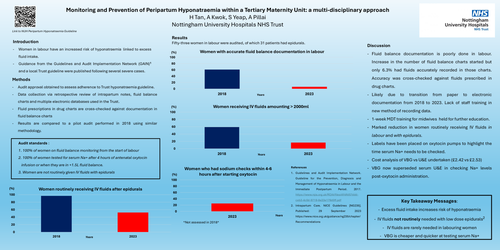
Fifty-three women in labour were audited, of which 31 patients had epidurals.
Discussion
-
- Fluid balance documentation is poorly done in labour. Increase in the number of fluid balance charts started but only 6.3% had fluids accurately recorded in those charts. Accuracy was cross-checked against fluids prescribed in drug charts.
-
- Likely due to transition from paper to electronic documentation from 2018 to 2023. Lack of staff training in new method of recording data.
-
- 1-week MDT training for midwives held for further education.
-
- Marked reduction in women routinely receiving IV fluids in labour and with epidurals.
-
- Labels have been placed on oxytocin pumps to highlight the time serum Na+ needs to be checked.
-
- Cost analysis of VBG vs U&E undertaken (£2.42 vs £2.53)
-
- VBG now superseded serum U&E in checking Na+ levels post-oxytocin administration.
Key Takeaway Messages:
- Excess fluid intake increases risk of hyponatraemia
- IV fluids not routinely needed with low dose epidurals2 - IV fluids are rarely needed in labouring women
- VBG is cheaper and quicker at testing serum Na+