150 posters, 16 sessions, 294 authors, 70 institutions
ePostersLive by SciGen Technologies S.A. All rights reserved.
Obstetric Anaesthesia Annual Scientific Meeting 2024
Thursday 9 - Friday 10 May 2024, Birmingham

6292830
Multidisciplinary team training is not just simulation... Anaesthetic trainee knowledge and understanding of Cardiotocography (CTG)
Part of Topic
Multidisciplinary team training is not just simulation…Anaesthetic trainee knowledge and understanding of Cardiotocography (CTG)
VP Laxton1, S Subramaniam1, C Khoo2, R Bedson1
1 Department of Anaesthesia, Queen Charlotte’s and Chelsea Hospital, London
2 Department of Obstetrics, Queen Charlotte’s and Chelsea Hospital, London
Introduction
CTG is the most widely used technique to assess fetal well-being in labour.1 Basic interpretation is a key capability requirement for Obstetric Anaesthetists aiding prediction and triage of emergency workload. Free online training modules exist but are tailored to Obstetricians and Midwives. An OAA sponsored survey in 2016 highlighted CTGs as an area for development that lacked resources for anaesthetists.2 One Ockenden report action was ‘staff who work together must train together’.3 As members of the MDT it is imperative for obstetric anaesthetists to have an understanding of CTGs; this helps predict potential theatre cases and their urgency as well as suitability and potential effects of regional labour analgesia and anaesthesia on the foetus. We assessed our trainees’ CTG knowledge and understanding
Method
As an educational quality improvement project ethics committee approval was not required. An anonymous survey asked trainees to self-assess their confidence, knowledge and understanding of CTGs. Additional questions included previous teaching and preferred teaching format. The foetal monitoring lead consultant obstetrician delivered bespoke CTG teaching for anaesthetists, and trainees were encouraged to attend weekly case based discussion (CBD) CTG teaching for obstetric staff. The survey was then repeated.
Results
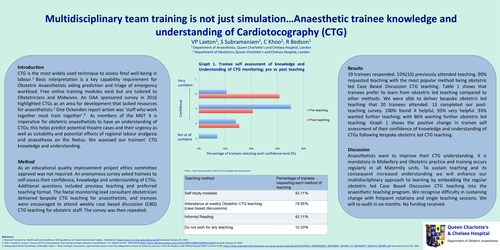
19 trainees responded. 52%(10) previously attended teaching. 90% requested teaching with the most popular method being obstetric led Case Based Discussion CTG teaching. Table 1 shows that trainees prefer to learn from obstetric led teaching compared to other methods. We were able to deliver bespoke obstetric led teaching that 20 trainees attended. 13 completed our post-teaching survey. 100% found it helpful, 93% very helpful. 93% wanted further teaching; with 86% wanting further obstetric led teaching. Graph 1 shows the positive change in trainee self assessment of their confidence of knowledge and understanding of CTGs following bespoke obstetric led CTG teaching.
Discussion
Anaesthetists want to improve their CTG understanding. It is mandatory in Midwifery and Obstetric practice and training occurs regularly in all Maternity units. To sustain teaching and its consequent increased understanding we will enhance our multidiscliplinary approach to learning by embedding the regular obstetric led Case Based Discussion CTG teaching into the anaesthetic teaching program. We recognise difficulty in sustaining change with frequent rotations and single teaching sessions. We will re-audit in six months. No funding received.