150 posters, 16 sessions, 294 authors, 70 institutions
ePostersLive by SciGen Technologies S.A. All rights reserved.
Obstetric Anaesthesia Annual Scientific Meeting 2024
Thursday 9 - Friday 10 May 2024, Birmingham

6290533
Improving access to obstetric difficult airway equipment and training in a Rwandan public hospital
Part of Topic
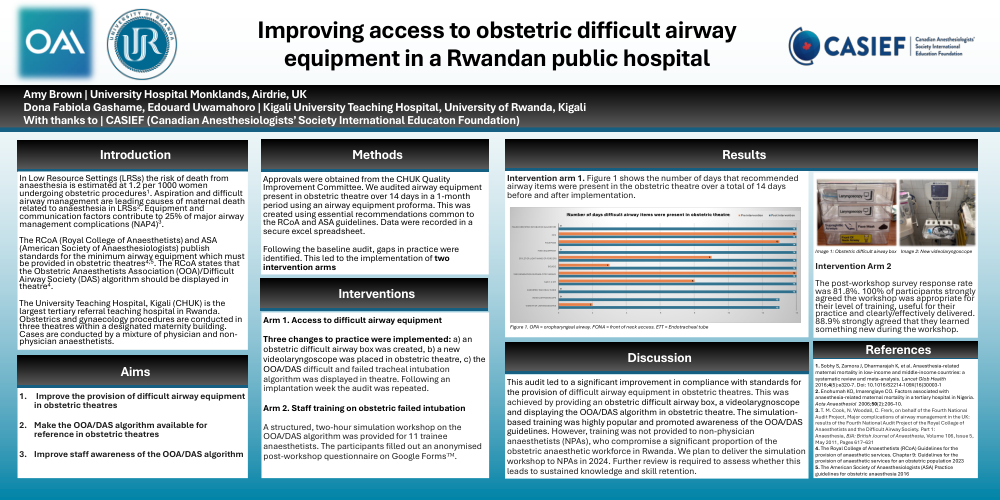
Improving access to obstetric difficult airway equipment in a Rwandan public hospital
Introduction: In Low Resource Settings (LRSs) the risk of death from anaesthesia is estimated at 1.2 per 1000 women undergoing obstetric procedures1. Aspiration and difficult airway management are leading causes of maternal death related to anaesthesia in LRSs2. Equipment and communication factors contribute to 25% of major airway management complications (NAP4)3.
The RCoA (Royal College of Anaesthetists) and ASA (American Society of Anaesthesiologists) publish standards for the minimum airway equipment which must be provided in obstetric theatres4,5. The RCoA states that the Obstetric Anaesthetists Association (OOA)/Difficult Airway Society (DAS) algorithm should be displayed in theatre4.
The University Teaching Hospital, Kigali (CHUK) is the largest tertiary referral teaching hospital in Rwanda. Obstetrics and gynaecology procedures are conducted in three theatres within a designated maternity building. Cases are conducted by a mixture of physician and non-physician anaesthetists.
Aims:
Methods: Approvals were obtained from the CHUK Quality Improvement Committee. We audited airway equipment present in obstetric theatre over 14 days in a 1-month period using an airway equipment proforma. This was created using essential recommendations common to the RCoA and ASA guidelines. Data were recorded in a secure excel spreadsheet.
Following the baseline audit, gaps in practice were identified. This led to the implementation of two intervention arms
Interventions: Arm 1. Access to difficult airway equipment
Three changes to practice were implemented: a) an obstetric difficult airway box was created, b) a new videolaryngoscope was placed in obstetric theatre, c) the OOA/DAS difficult and failed tracheal intubation algorithm was displayed in theatre. Following an implantation week the audit was repeated.
Arm 2. Staff training on obstetric failed intubation
A structured, two-hour simulation workshop on the OOA/DAS algorithm was provided for 11 trainee anaesthetists. The participants filled out an anonymised post-workshop questionnaire on Google FormsÔ.
Results: Intervention arm 1. Figure 1 shows the number of days that recommended airway items were present in the obstetric theatre over a total of 14 days before and after implementation.
Intervention Arm 2
The post-workshop survey response rate was 81.8%. 100% of participants strongly agreed the workshop was appropriate for their level of training, useful for their practice and clearly/effectively delivered. 88.9% strongly agreed that they learned something new during the workshop.
Discussion: This audit led to a significant improvement in compliance with standards for the provision of difficult airway equipment in obstetric theatres. This was achieved by providing an obstetric difficult airway box, a videolarygnoscope and displaying the OOA/DAS algorithm in obstetric theatre. The simulation-based training was highly popular and promoted awareness of the OOA/DAS guidelines. However, training was not provided to non-physician anaesthetists (NPAs), who compromise a significant proportion of the obstetric anaesthetic workforce in Rwanda. We plan to deliver the simulation workshop to NPAs in 2024. Further review is required to assess whether this leads to sustained knowledge and skill retention.