150 posters, 16 sessions, 294 authors, 70 institutions
ePostersLive by SciGen Technologies S.A. All rights reserved.
Obstetric Anaesthesia Annual Scientific Meeting 2024
Thursday 9 - Friday 10 May 2024, Birmingham

6273108
An educational programme to increase the use of remifentanil for labour analgesia
Poster Presenter
Authors
Part of Topic
An educational programme to increase the use of remifentanil for labour analgesia
Background
Remifentanil patient-controlled intravenous analgesia (PCIA) is recommended by NICE for consideration as labour analgesia[1], yet at our institution its use remains infrequent. Reasons for this include lack of familiarity and confidence of the midwifery team, and staff shortages making use of remifentanil more challenging.
We undertook a project to assess the issues surrounding remifentanil PCIA use in our unit, and address any educational deficits that were identified among midwifery staff.
Method
We first undertook a survey assessing knowledge of remifentanil PCIA use for labour analgesia, and providing an opportunity to voice concerns about the technique. Based on the results, we produced an educational programme including the following resources:
1) An educational video to highlight some of the information required for safe and effective use of remifentanil PCIA for labour analgesia
2) A quick-reference summary to be used by midwives required to care for a patient using a remifentanil PCIA
3) Anaesthetist-led seminar sessions aiming to answer questions and discuss concerns
We then repeated the survey for participants in the educational programme to assess for any improvements in knowledge and confidence.
Results
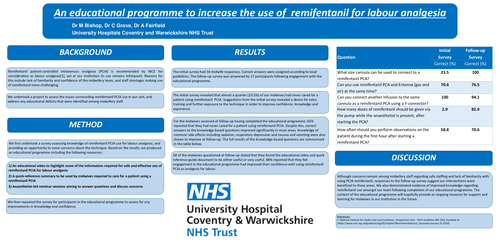
The initial survey had 34 midwife responses. Correct answers were assigned according to local guidelines. The follow-up survey was answered by 17 participants following engagement with the educational programme.
The initial survey revealed that almost a quarter (23.5%) of our midwives had never cared for a patient using remifentanil PCIA. Suggestions from the initial survey revealed a desire for extra training and further exposure to the technique in order to improve confidence, knowledge and experience.
For the midwives assessed at follow-up having completed the educational programme, 65% reported that they had never cared for a patient using remifentanil PCIA. Despite this, correct answers to the knowledge-based questions improved significantly in most areas. Knowledge of common side effects including sedation, respiratory depression and nausea and vomiting were also shown to improve at follow-up. The full results of the knowledge-based questions are summarised in the table below.
All of the midwives questioned at follow-up stated that they found the educational video and quick reference guide document to be either useful or very useful. 88% reported that they felt engagement in the educational programme had improved their confidence with using remifentanil PCIA as analgesia for labour.
Discussion
Although concerns remain among midwifery staff regarding safe staffing and lack of familiarity with using PCIA remifentanil, responses to the follow-up survey suggest our interventions were beneficial to these areas. We also demonstrated evidence of improved knowledge regarding remifentanil use amongst our team following completion of our educational programme. The content of the educational programme will hopefully provide an ongoing resource for support and learning for midwives in our institution in the future.
References:
1. National Institute for Health and Care Excellence. Intrapartum Care – NICE Guideline [NG 235]. Available at [https://www.nice.org.uk/guidance/ng235/chapter/Recommendations]. [accessed January 25 2024]