150 posters, 16 sessions, 294 authors, 70 institutions
ePostersLive by SciGen Technologies S.A. All rights reserved.
Obstetric Anaesthesia Annual Scientific Meeting 2024
Thursday 9 - Friday 10 May 2024, Birmingham

6301562
Impact of vaginal haemorrhage- is cell salvage the missing link?
Poster Presenter
Authors
Jo Gumley, Alexandra Wright, Matthew Caine, Jonathan Collins, Grainne Garvey, Helen McNamara
Affiliations
Specialist Registrar, Department of Anaesthesia, Liverpool Women's Hospital, UK, Core Trainee, Department of Anaesthesia, Liverpool Women's Hospital, UK, Consultant Anaesthetist, Department of Anaesthesia, Liverpool Women's Hospital, UK
Part of Topic
Impact of vaginal haemorrhage - is cell salvage the missing link?
Jo Gumley, Alexandra Wright, Matthew Caine, Jonathan Collins, Grainne Garvey, Helen McNamara
Department of Anaesthesia, Liverpool Women's Hospital, UK
Introduction
Vaginal haemorrhage is a significant source of obstetric bleeding, with 18% of instrumental deliveries losing >1000 ml of blood (comparable to 20% for emergency caesarean sections) [1]. Whilst cell salvage is commonly used at caesarean section, its use for vaginal blood loss is currently limited by lack of data regarding safety and feasibility [2]. Our aim was to record the impact of vaginal blood loss on patients recently discharged from a major obstetric hospital, to assess clinical need and patient acceptability of vaginal cell salvage with a view to potentially guide future studies.
Methods
This study was a retrospective cohort study with additional patient survey.
Following trust audit department approval, obstetric patients were identified who lost more than 1000 ml blood during theatre procedures for either instrumental delivery or retained placenta throughout the period 01/06/2023 to 31/11/2023.
Electronic patient records were reviewed, and the following data was recorded where available:
Subsequently, identified patients were contacted by telephone and, after verbal consent, were asked about the impact of anaemia, iron therapy and the hypothetical acceptability of vaginal cell salvage, had this been available.
Results
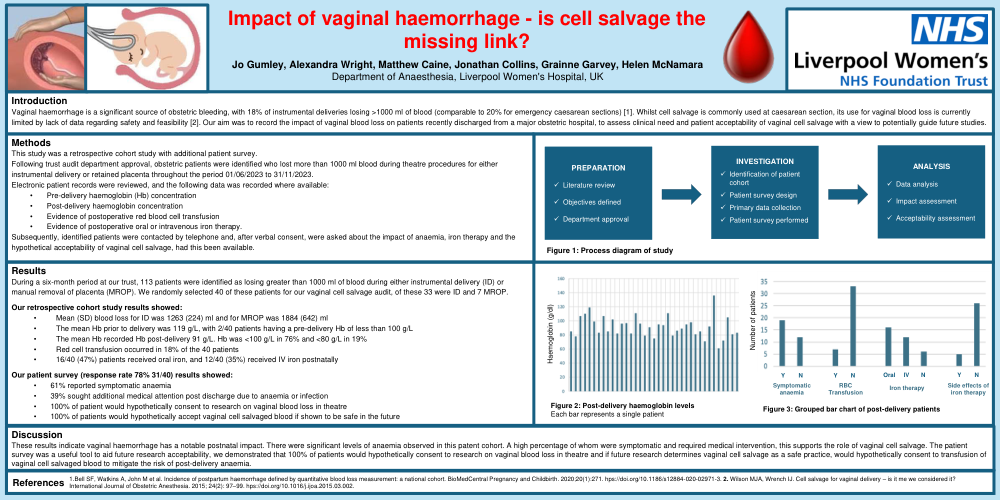
During a six-month period at our trust, 113 patients were identified as losing greater than 1000 ml of blood during either instrumental delivery (ID) or manual removal of placenta (MROP). We randomly selected 40 of these patients for our vaginal cell salvage audit, of these 33 were ID and 7 MROP.
Our retrospective cohort study results showed:
Our patient survey (response rate 78% 31/40) results showed:
Discussion
These results indicate vaginal haemorrhage has a notable postnatal impact. There were significant levels of anaemia observed in this patent cohort. A high percentage of whom were symptomatic and required medical intervention, this supports the role of vaginal cell salvage. The patient
survey was a useful tool to aid future research acceptability, we demonstrated that 100% of patients would hypothetically consent to research on vaginal blood loss in theatre and if future research determines vaginal cell salvage as a safe practice, would hypothetically consent to transfusion of
vaginal cell salvaged blood to mitigate the risk of post-delivery anaemia.
References
1.Bell SF, Watkins A, John M et al. Incidence of postpartum haemorrhage defined by quantitative blood loss measurement: a national cohort. BioMedCentral Pregnancy and Childbirth. 2020;20(1):271. hps://doi.org/10.1186/s12884-020-02971-3. 2. Wilson MJA, Wrench IJ. Cell salvage for vaginal delivery – is it me we considered it? International Journal of Obstetric Anesthesia. 2015; 24(2): 97–99. hps://doi.org/10.1016/j.ijoa.2015.03.002.