150 posters, 16 sessions, 294 authors, 70 institutions
ePostersLive by SciGen Technologies S.A. All rights reserved.
Obstetric Anaesthesia Annual Scientific Meeting 2024
Thursday 9 - Friday 10 May 2024, Birmingham

6300845
Management of blood loss and coagulopathy in post-partum haemorrhage at a geographically remote district general hospital
Poster Presenter
Authors
Part of Topic
Management of blood loss and coagulopathy in post-partum haemorrhage at a geographically remote district general hospital
Phillips D, Al Bushe Ade K, Pritchett CSA
Royal Cornwall Hospitals Trust
Introduction
Post-partum haemorrhage (PPH) continues to be a major cause of maternal morbidity and mortality within the UK and has been a focus for improved management in recent years. The Obstetric Bleeding Strategy (OBS) studies set out strategies for reducing major haemorrhage and transfusion requirements, including the use of rotational thromboelastometry (ROTEM) in haemorrhages >1000ml. [1] [2]
At the Royal Cornwall Hospital (RCH) we complete approximately 4000 deliveries annually in a geographically isolated area, where access to blood products can be logistically difficult.
We use cell salvage for all caesarean sections and have access to a ROTEM Sigma located in blood bank.
We had initial difficulties in establishing ROTEM usage on our delivery suite. This included the COVID 19 pandemic impacting on implementation and staff training. This was followed by machine breakages due to transport of the mobile ROTEM machine.
Methods
We collected data from Euroking for all declared PPH >1000mls over 17 months from 01/07/22- 14/12/23. We analysed the use of ROTEM and standard lab tests of coagulation (SLTs) taken within 30 minutes of declared PPH. Additionally, Major Obstetric Haemorrhage (MOH) blood bank alerts and use of blood products, including cell salvage were collected.
Results
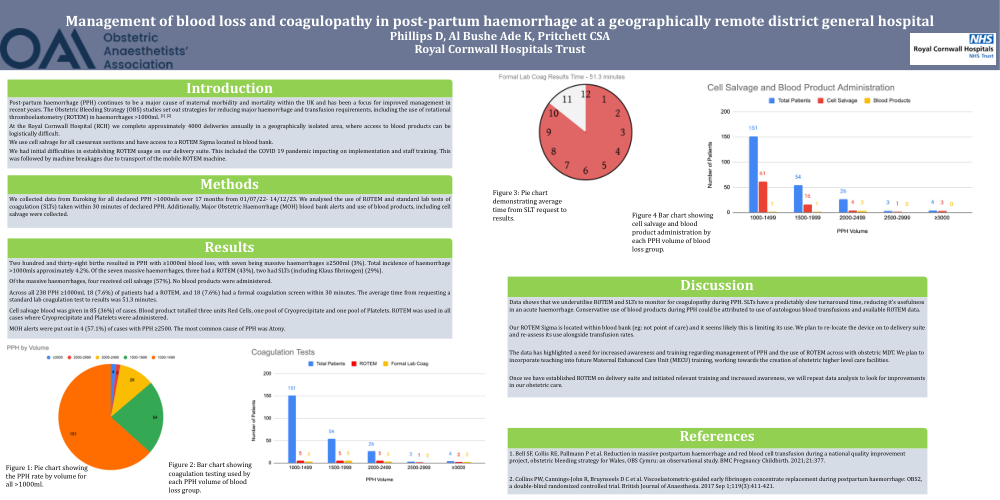
Two hundred and thirty-eight births resulted in PPH with ≥1000ml blood loss, with seven being massive haemorrhages ≥2500ml (3%). Total incidence of haemorrhage >1000mls approximately 4.2%. Of the seven massive haemorrhages, three had a ROTEM (43%), two had SLTs (including Klaus fibrinogen) (29%).
Of the massive haemorrhages, four received cell salvage (57%). No blood products were administered.
Across all 238 PPH ≥1000ml, 18 (7.6%) of patients had a ROTEM, and 18 (7.6%) had a formal coagulation screen within 30 minutes. The average time from requesting a standard lab coagulation test to results was 51.3 minutes.
Cell salvage blood was given in 85 (36%) of cases. Blood product totalled three units Red Cells, one pool of Cryoprecipitate and one pool of Platelets. ROTEM was used in all cases where Cryoprecipitate and Platelets were administered.
MOH alerts were put out in 4 (57.1%) of cases with PPH ≥2500. The most common cause of PPH was Atony.
Discussion
Data shows that we underutilise ROTEM and SLTs to monitor for coagulopathy during PPH. SLTs have a predictably slow turnaround time, reducing it’s usefulness in an acute haemorrhage. Conservative use of blood products during PPH could be attributed to use of autologous blood transfusions and available ROTEM data.
Our ROTEM Sigma is located within blood bank (eg: not point of care) and it seems likely this is limiting its use. We plan to re-locate the device on to delivery suite and re-assess its use alongside transfusion rates.
The data has highlighted a need for increased awareness and training regarding management of PPH and the use of ROTEM across with obstetric MDT. We plan to incorporate teaching into future Maternal Enhanced Care Unit (MECU) training, working towards the creation of obstetric higher level care facilities.
Once we have established ROTEM on delivery suite and initiated relevant training and increased awareness, we will repeat data analysis to look for improvements in our obstetric care.
References
1. Bell SF, Collis RE, Pallmann P et al. Reduction in massive postpartum haemorrhage and red blood cell transfusion during a national quality improvement project, obstetric bleeding strategy for Wales, OBS Cymru: an observational study. BMC Pregnancy Childbirth. 2021;21:377.
2. Collins PW, Cannings-John R, Bruynseels D C et al. Viscoelastometric-guided early fibrinogen concentrate replacement during postpartum haemorrhage: OBS2, a double-blind randomized controlled trial. British Journal of Anaesthesia. 2017 Sep 1;119(3):411-421.