150 posters, 16 sessions, 294 authors, 70 institutions
ePostersLive by SciGen Technologies S.A. All rights reserved.
Obstetric Anaesthesia Annual Scientific Meeting 2024
Thursday 9 - Friday 10 May 2024, Birmingham

6285595
Back pain in pregnancy -- red flags and challenges
Poster Presenter
Authors
Affiliations
Part of Topic
Back pain in pregnancy – red flags and challenges
Introduction
Pregnancy-associated breast cancer (PABC), diagnosed in 0.03% of pregnancies [1], is the most common cancer during pregnancy. We describe a late presentation of PABC necessitating early delivery and urgent spinal stabilisation.
Case Report
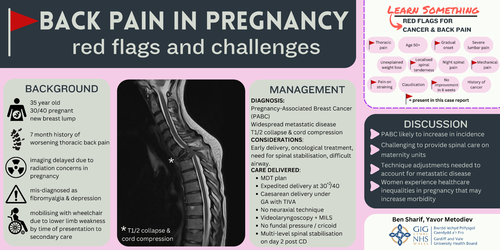
A 35-year-old pregnant woman (30/40) was referred to secondary care with a new breast lump. She had a 30-week history of worsening thoracic back pain, unrelieved by conservative treatment and physiotherapy. Initially misdiagnosed with depression and fibromyalgia, spinal imaging was delayed due to pregnancy-related radiation concerns. New lower limb weakness developed prior to the diagnosis of breast cancer. Urgent MRI (Fig. 1) revealed spinal cord compression and vertebral collapse due to widespread metastatic disease.
A multidisciplinary team (MDT) formulated a treatment plan, weighing the risks of early delivery, radiotherapy, and spinal stabilization. A caesarean delivery (CD) was performed 48 hours after presentation. Neuraxial anaesthesia and fundal pressure were avoided, and videolaryngoscopy with manual in-line stabilisation was used. Multi-level spinal stabilisation proceeded on day 2 post-CD.
Lack of familiarity amongst maternity staff with spinal precautions was challenging, requiring support from external teams. Rapid co-ordination of the MDT was essential to ensure a timely and risk-balanced delivery.
Discussion
The incidence of PABC is likely to increase as patients delay childbearing. Physiological changes of breast tissue affect mammogram sensitivity [1]. Most oncological treatments are contraindicated in pregnancy [2]. Red flags associated with back pain were present throughout this case, but diagnosis was likely delayed due to pregnancy. Significant disease progression then increased the morbidity. This demonstrates the potential health inequalities that pregnant patients can experience. This case highlighted the importance of MDT work in order to expedite delivery and ongoing management.